How to Write Salon Service Descriptions That Sell (With Examples)
Updated:
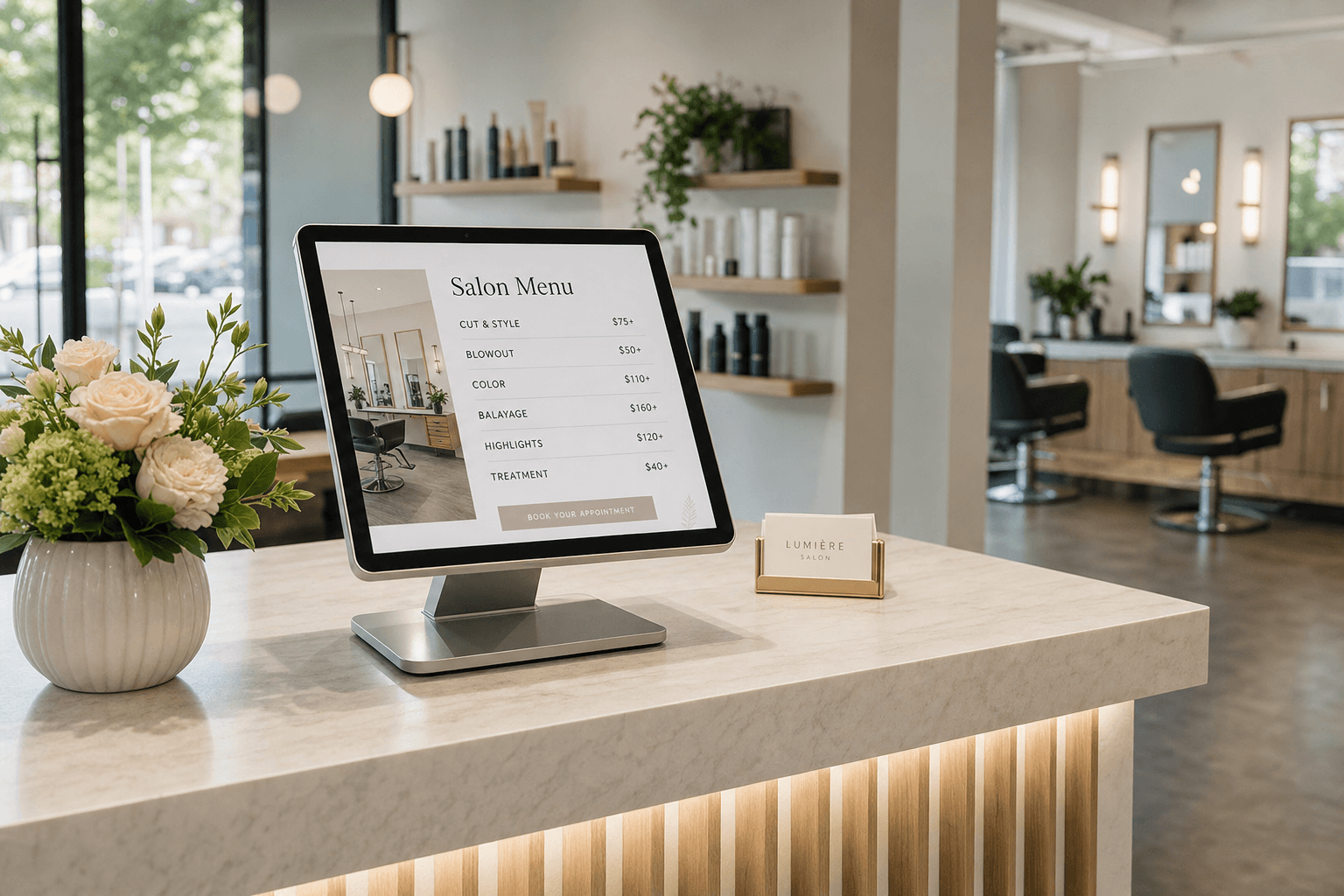
Most salon service menus read like a spreadsheet. "Haircut – $45." "Full Set – $65." "Deep Tissue Massage – 60 min." That's it. No context, no texture, no reason for a client to feel anything about choosing one service over another.
The problem isn't that salon owners don't care about their services — they absolutely do. The problem is that most people write descriptions the way they'd fill out a form, not the way they'd talk to a client sitting in their chair. And that gap costs real money: in upsells not made, in premium services underbooked, and in first-time visitors who couldn't tell why your $120 color service was worth it over the $60 one down the street.
This guide will show you exactly how to write service descriptions that do the selling for you — whether they live on your digital salon menu, your website, or a QR code page clients scan in your waiting area.
Why Descriptions Matter More Than You Think
When a new client lands on your service menu, they're doing three things at once: figuring out what you offer, deciding whether your prices feel fair, and looking for a reason to trust you. A bare list of service names and prices answers the first question but fails the other two.
Good descriptions do the following:
- Reduce anxiety. First-time clients don't know what to expect. A clear description tells them what will happen, how long it takes, and what the result will look like — before they ever walk through your door.
- Justify pricing. When a client reads "Signature Facial – $95" with no explanation, $95 feels arbitrary. When they read what's included, what skin concerns it addresses, and what products are used, $95 feels earned.
- Drive upgrades. A well-written description of your premium service makes the standard option feel like a compromise. That's not manipulation — it's helping clients understand the difference in value.
- Filter the right clients. Specific descriptions attract clients who are genuinely excited about your work and repel those who were going to quibble over price anyway.
The Anatomy of a Strong Service Description
You don't need to write a novel. The best salon service descriptions are 2–4 sentences long and cover four elements:
- What it is (in plain language, not industry jargon)
- What it does (the benefit or transformation, not just the process)
- Who it's for (the client type or concern it addresses)
- What makes it yours (a technique, product, or detail that's specific to your salon)
You won't always hit all four in every description — sometimes two or three is enough. But when you're missing most of them, you've got a line item, not a description.
Before-and-After Examples by Service Type
Hair Salon: Color Services
Before: "Balayage – Starting at $150"
After: "Balayage — Starting at $150. Hand-painted highlights applied freehand for a sun-kissed, natural grow-out that doesn't require a touch-up every six weeks. Ideal for clients who want low-maintenance color with a high-impact result. Includes a toning gloss and blowout."
Notice what changed: the after version tells the client exactly why balayage is worth more than a traditional highlight, addresses the maintenance concern before the client even asks, and specifies what's included in the price. "Starting at" is still there — but now it feels transparent rather than vague.
Hair Salon: Treatments
Before: "Keratin Treatment – $200 / 2 hours"
After: "Smoothing Keratin Treatment — $200 / approx. 2 hours. A professional-grade smoothing treatment that eliminates frizz, cuts drying time in half, and leaves hair glossy and manageable for up to four months. Best for thick, coarse, or chemically-treated hair. Results are noticeable from the first wash."
The original description told the client nothing they couldn't already guess. The new one answers the question every keratin client has: "How long will it last, and will it actually work on my hair?"
Nail Salon: Enhancements
Before: "Acrylic Full Set – $65"
After: "Acrylic Full Set — $65. Sculpted acrylic extensions built to your preferred length and shape, finished with your choice of gel color or classic polish. Durable, chip-resistant, and customizable. Perfect for clients who want length, strength, or a blank canvas for nail art. Fills recommended every 2–3 weeks."
The added detail about fills is smart — it sets expectations and plants the seed for a recurring appointment without being pushy.
Nail Salon: Manicures
Before: "Deluxe Manicure – $45"
After: "Deluxe Manicure — $45. Our upgraded manicure includes an extended soak, cuticle treatment, exfoliating sugar scrub, heated paraffin dip, and a 10-minute hand massage before your color application. If you've never treated your hands to the full experience, this is the place to start."
The last sentence does something subtle but effective: it positions the deluxe service as the standard worth trying, not an indulgence to feel guilty about.
Spa: Massage
Before: "Hot Stone Massage – 60 min / $110"
After: "Hot Stone Massage — 60 min / $110. Smooth basalt stones are heated and used alongside hands-on massage to melt deep muscle tension and improve circulation. The heat penetrates further than hands alone, making this ideal for clients with chronic tightness, cold sensitivity, or anyone who simply wants to feel completely unwound. One of our most-requested services."
That final line — "one of our most-requested services" — is social proof in six words. It reassures a first-time client that they're making a safe, popular choice.
Barbershop: Haircut Services
Before: "Fade – $30"
After: "Fade — $30. A precision fade cut to your preferred level — low, mid, or high — blended seamlessly into your style on top. Finished with a straight-razor cleanup on the neck and edges. Clean. Sharp. Done right."
Short, confident, and specific. The last three words match the voice a barbershop client expects. Your description should sound like your brand, not a corporate brochure.
Language That Works — and Language That Doesn't
Words and phrases to use
- Sensory language: "glossy," "silky," "deeply relaxing," "crisp," "luminous" — these create a feeling before the client even arrives.
- Outcome language: "leaves hair manageable for up to 4 months," "reduces breakage," "visibly brightens skin tone" — these are results, not processes.
- Specificity: Name the products you use (especially if they're premium), name the technique, name the time. "10-minute scalp massage" is more compelling than "includes massage."
- Social proof cues: "our most popular," "client favorite," "frequently requested" — these reduce decision anxiety.
Words and phrases to avoid
- Vague superlatives: "amazing," "incredible," "the best" — these mean nothing without evidence.
- Jargon without explanation: "Olaplex treatment" is great if your clients know what Olaplex is. If they don't, say "Olaplex bond-repair treatment that rebuilds damaged hair structure from the inside out."
- Passive, lifeless language: "Service is provided by trained professionals" tells a client nothing about why they should care.
- Padding: "This luxurious, pampering experience is designed to…" — cut to the point. Clients are skimming.
How to Structure Your Menu So Descriptions Get Read
Even the best description won't help if it's buried in a cluttered, hard-to-navigate menu. Structure matters. A few principles that work:
- Group services logically. Hair, color, treatments, and styling should each be their own section. Don't make clients hunt.
- Lead with your best services. Put your highest-margin or most-differentiated services at the top of each section. People read menus like they read pages — top to bottom, with attention dropping off quickly.
- Use a consistent format. Service name, price, description. Every time. Inconsistency creates friction.
- Don't bury the price. Clients who have to dig for pricing feel tricked. Show it clearly alongside the description.
If you're building or refreshing your menu, MenuHoster's salon menu templates are designed with this kind of structure built in — so you're not starting from a blank page.
Writing Descriptions for Add-Ons and Upgrades
Add-ons are where a lot of salons leave money on the table. A client who books a basic manicure might happily add a paraffin dip or a nail art accent — but only if they know it exists and understand what it costs.
Add-on descriptions should be even more concise than main service descriptions. One sentence is often enough:
- "Paraffin Dip — +$12. A warm wax treatment that softens dry skin and seals in moisture. Add to any manicure or pedicure."
- "Scalp Treatment — +$20. A targeted serum applied directly to the scalp to address dryness, buildup, or thinning. Works with any cut or color service."
- "Beard Lineup — +$10. Straight-razor definition on the cheek and neckline. Worth it."
That last example is three words of opinion, but it works because it's direct and confident. Don't be afraid to editorialize briefly — it makes the menu feel human.
Putting Your Descriptions Where Clients Will Actually See Them
Writing great descriptions is only half the job. They need to be visible at the right moments: when a client is deciding whether to book, when they're waiting in your reception area, and when they're choosing between services.
A digital menu solves this cleanly. Unlike a printed service list that goes stale the moment you change a price or add a service, a digital menu can be updated instantly and accessed from anywhere — your website, a link in your Instagram bio, or a QR code on your front desk.
Speaking of QR codes: placing a QR code menu in your waiting area gives clients something useful to do while they wait, and it's one of the most natural moments to browse add-ons and upgrades. A client waiting for their color to process is a captive audience — give them something to read that might prompt them to ask about a gloss or a treatment.
If you're using your menu to support premium pricing, the descriptions do especially heavy lifting. A well-crafted description that explains the skill, time, and product investment behind a service makes a higher price feel logical rather than arbitrary. We've written more about this in our guide on using a digital salon menu to justify premium pricing.
A Simple Editing Checklist
Before you publish any service description, run through these questions:
- Does it say what the service actually does for the client (not just what it is)?
- Does it mention who it's best for, or what problem it solves?
- Does it include at least one specific detail (a product, a technique, a time, a result)?
- Is the price visible and clearly tied to the description?
- Is it free of filler words and vague superlatives?
- Does it sound like your salon — not like a generic brochure?
If you can check all six boxes, you have a description that works. If you're missing two or more, it needs another pass.
Frequently Asked Questions
How long should a salon service description be?
Two to four sentences is the sweet spot for most services. Long enough to communicate value and set expectations, short enough that clients will actually read it. Add-ons and minor services can be even shorter — one sentence is fine. Reserve longer descriptions for your signature or premium services where the extra detail genuinely helps justify the price.
Should I write descriptions for every single service, or just the main ones?
Start with your highest-value and most-booked services — these have the biggest impact on revenue. Then work your way through add-ons and upgrades, since those descriptions directly drive ticket size. Basic services that clients already understand (like a standard trim) can get away with shorter copy, but even a single sentence of differentiation helps.
What if I'm not a confident writer?
Start by talking, not writing. Record yourself explaining a service to a new client — what it is, what it does, who it's for. Then transcribe that and clean it up. That's almost always better than trying to write from scratch. You can also use AI tools like ChatGPT to draft a first version based on bullet points you provide, then edit it to match your voice.
How often should I update my service descriptions?
Review your descriptions whenever you change pricing, add a new service, switch products, or notice that a particular service is consistently underbooked. If a service isn't selling and the price seems fair, the description is often the first thing worth revisiting. A digital menu makes this easy — you're not reprinting anything.
Can good descriptions really affect how much clients spend?
Yes, and the mechanism is straightforward: clients who understand what an upgrade includes are far more likely to choose it. When the difference between a basic manicure and a deluxe manicure is explained clearly — specific steps, specific benefits — the upgrade sells itself. Many salons report meaningful increases in average ticket size after rewriting their menus, simply because clients finally understood what they were being offered.
Ready to put your new service descriptions to work? MenuHoster makes it easy to build a professional digital salon menu in minutes — no design skills required. Update your services, prices, and descriptions anytime, share your menu via QR code or link, and give every client a reason to book more. Create your salon menu on MenuHoster today and start turning browsers into loyal, high-value clients.
MenuHoster Team
Helping restaurants go digital