Salon Social Proof: Turning Happy Clients into Marketing
Updated:
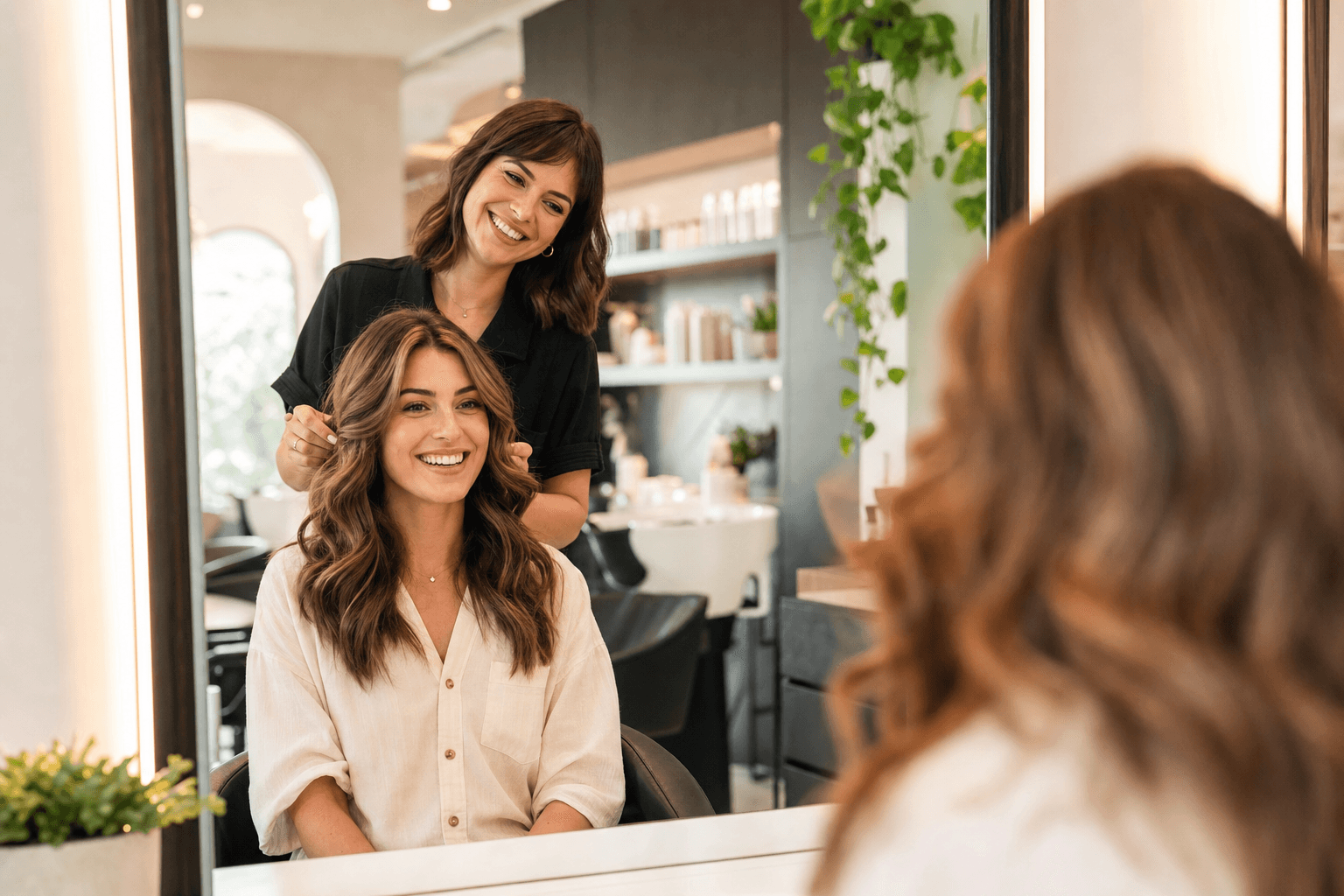
Word of mouth has always been the lifeblood of salons, barbershops, nail studios, and spas. A friend's recommendation carries more weight than any paid ad. The difference today is that word of mouth now lives online — in Google reviews, Instagram comments, TikTok videos, and tagged photos — where it can reach hundreds of potential clients instead of just a handful. That's social proof, and if you're not actively collecting and displaying it, you're leaving new bookings on the table.
This guide breaks down exactly how to turn the clients who already love your work into a marketing engine that runs almost on its own.
What Social Proof Actually Means for Salons
Social proof is any signal that tells a potential client, "Other people have tried this and loved it." For a salon, that includes:
- Star ratings and written reviews on Google, Yelp, or Facebook
- Before-and-after photos posted by clients or shared with permission
- Tagged posts and Stories on Instagram or TikTok
- Testimonials on your website or booking page
- Referrals — when a happy client sends a friend your way
- Press mentions or features in local media
Each of these does a specific job. Reviews handle search credibility. Photos prove your skill visually. Referrals deliver warm leads who are already pre-sold. A strong social proof strategy uses all of them, not just one.
Make It Easy to Leave a Review
The single biggest reason salons don't have more reviews is friction. Clients mean to leave one, then forget or can't find the link. Your job is to remove every obstacle.
Ask at the right moment
The best time to ask for a review is right after the service, while the client is still in the chair or standing at the front desk admiring their result. Not two days later via email. At that moment, their satisfaction is highest and the experience is fresh. A simple, direct ask works: "We'd love it if you left us a quick Google review — it really helps us out." Most happy clients are glad to help when asked sincerely.
Use a short, direct link
Don't send clients to Google's homepage and ask them to search for you. Create a direct link to your Google review form (search "Google review link generator" and enter your business name) and shorten it with a free tool like Bitly. Put that link everywhere: your booking confirmation texts, your email signature, your front desk counter, and your QR codes.
Put a QR code at checkout
A small tent card or sticker at the front desk with a QR code linking straight to your review page is one of the highest-converting review tactics available. Clients can tap and scan in seconds while they're paying. If you already use QR codes in your salon for menus and booking, adding a review QR code to the same setup is a natural extension.
Follow up with a text or email
For clients who didn't review on the spot, a follow-up message 24 hours later is appropriate. Keep it short: thank them, mention you'd appreciate a review, and include the direct link. One follow-up is fine. Two starts to feel pushy. Never offer a discount or gift in exchange for a positive review — that violates Google's policies and can get your listing penalized.
Before-and-After Photos: Your Most Powerful Content
In a visual industry, nothing sells your skill better than a clear, well-lit before-and-after. A potential client scrolling Instagram can immediately see what you're capable of. No caption needed.
Build photo consent into your process
Before you reach for your phone, ask permission. A quick verbal ask is fine for most clients, but having a simple written consent option in your intake form protects you and makes the process feel professional. Some clients will say no — respect that without hesitation. Most, especially those who are thrilled with their results, will say yes.
Shoot consistently
Good before-and-after photos don't require a professional camera, but they do require consistency. Use the same spot in your salon, the same angle, and good natural or ring-light lighting every time. Shoot the "before" at the start of the appointment, not after you've already started working. For detailed work — nail art, balayage, precision cuts — get close enough that the detail is actually visible. For more guidance on technique, see our article on how to photograph salon work for a professional portfolio.
Post with context, not just the image
A before-and-after with zero caption is a missed opportunity. Add a brief description: the service performed, the technique used, the client's starting point and goal. This helps you rank in local search (Instagram and TikTok are increasingly used as search engines), and it educates potential clients about what's possible. Tag the client if they're comfortable with it — their network sees the post and you gain reach for free.
Turn Client Content into Marketing Assets
When a client posts a photo of their fresh blowout or new nail set and tags your salon, that's user-generated content (UGC) — and it's more trustworthy to new clients than anything you post yourself because it comes from a real person with no financial incentive.
Repost tagged content strategically
When a client tags you, thank them in the comments and, with their permission, repost to your own feed or Stories. Tools like Instagram's native repost feature or apps like Later make this easy. Build a habit of checking your tags a few times a week and resharing the best ones.
Create a branded hashtag
Encourage clients to use a consistent hashtag — something like #StylesByMaria or #CutsByKingsBarbershop — so you can easily find and collect their posts. Mention it on your mirror cards, your receipts, and your social bios. A branded hashtag also builds a searchable gallery of real client results that anyone can browse.
Feature testimonials on your service menu and booking page
Most salons collect reviews but never display them anywhere except Google. Pull your best quotes and put them on your digital salon menu or booking page. A potential client who lands on your menu page and sees five glowing testimonials alongside your service list is far more likely to book than one who sees prices alone. Even two or three strong quotes make a measurable difference.
Build a Referral System That Actually Works
Referrals are the highest-quality leads you can get — they arrive pre-warmed by a trusted friend's recommendation. But most salons leave referrals entirely to chance. A simple, structured referral program turns occasional word-of-mouth into a reliable channel.
Keep the incentive simple and fair
The most effective referral programs offer something valuable to both parties: the referring client and the new client. A common structure is a discount or credit for the referring client when their friend completes a first appointment, plus a small welcome discount for the new client. Avoid making the reward so complex that clients can't remember or explain it.
Make it easy to share
A referral program that lives only in your head or on a laminated card at the desk won't get used much. Build it into your booking confirmation messages, your post-appointment follow-ups, and your email newsletter. A direct link clients can text to a friend removes all friction. If you send appointment reminders, add a one-line referral mention at the bottom.
Track it so you can improve it
Ask new clients how they heard about you — every time, at every appointment. Log it. If referrals are your top source, invest more in the program. If they're low, something is wrong with the ask or the incentive. You can't improve what you don't measure.
Respond to Every Review — Positive and Negative
Responding to reviews is itself a form of social proof. When potential clients read your Google listing and see that you personally reply to every review — thanking happy clients, addressing concerns from unhappy ones — it signals that you're professional, attentive, and that the experience in your chair will reflect that same care.
Responding to positive reviews
Keep it brief and personal. Use the client's name, mention a specific detail from their review if possible, and invite them back. Avoid copy-pasting the same response to every review — it looks automated and undermines the authenticity you're trying to project.
Responding to negative reviews
Stay calm, be professional, and never argue. Acknowledge the concern, apologize for the experience without admitting fault where it isn't warranted, and offer to resolve it offline. A gracious response to a critical review often impresses potential clients more than a string of five-stars with no owner responses. It shows you take quality seriously.
Display Social Proof Where Clients Make Decisions
Collecting reviews and photos is only half the job. The other half is making sure potential clients actually see them at the moment they're deciding whether to book.
- Your booking page or website: Pull in your Google star rating and display it prominently. Add 2–3 written testimonials near your "Book Now" button.
- Your digital service menu: A well-designed spa or salon service menu can include a short testimonials section alongside your treatments and pricing, reinforcing trust right where the buying decision happens.
- Your social media bio: Link to your Google reviews or include your star rating in your bio text. Something like "⭐ 4.9 on Google · 200+ reviews" is a powerful trust signal for anyone landing on your profile.
- Your physical space: A framed printout of your best reviews, a "Wall of Fame" with before-and-afters, or a small sign showing your Google rating near the front desk all reinforce trust for walk-ins and waiting clients.
- Your QR codes: If you use QR codes for menus or booking, consider adding a second code that links to your reviews page. Clients waiting in the chair often scan out of curiosity.
Consistency Beats Campaigns
The salons with the most impressive review counts and social followings didn't get there through one big push. They got there by asking every client, posting every week, and responding to every review — month after month. Social proof compounds over time. A salon with 300 Google reviews and a steady stream of tagged client photos is nearly impossible for a competitor to displace quickly, even with a bigger ad budget.
Build the habits first: ask for a review after every appointment, shoot a before-and-after whenever a client consents, repost tagged content twice a week, respond to reviews within 24 hours. Once those habits are in place, layer in a referral program and start pulling testimonials onto your booking pages. The whole system takes maybe 20 minutes a day once it's running.
If you want to see how your service menu and social proof can work together, explore the salon and spa menu templates on MenuHoster — many are designed with space for testimonials and photo galleries built right in.
Frequently Asked Questions
How many Google reviews does a salon need to look credible?
There's no magic number, but research consistently shows that most consumers want to see at least 10–15 reviews before they trust a business, and a rating above 4.5 stars is the threshold where most people feel comfortable booking. Getting to 50+ reviews puts you in a strong position against most local competitors. Focus on consistent quality and consistent asking — the numbers follow naturally.
Can I ask clients to update a negative review after I've resolved their issue?
Yes, and it's completely appropriate. Once you've resolved a complaint to the client's satisfaction, you can politely let them know they're welcome to update their review if they feel it reflects their overall experience. Don't pressure them, but many clients are happy to revise a review when they feel genuinely heard and helped.
Is it worth paying for ads if I have strong social proof?
Strong social proof makes your paid ads more effective — a Google ad that links to a listing with 200 five-star reviews converts much better than one linking to a listing with 8 reviews. But social proof can also reduce your dependence on paid ads over time, as organic referrals and search traffic grow. Think of social proof as the foundation; ads are an accelerant on top of it.
What's the best platform for salon reviews — Google, Yelp, or Facebook?
Google is the highest priority for most salons because Google reviews influence local search rankings and appear directly in Maps results. Yelp still matters in some markets, particularly for spas and upscale salons. Facebook reviews are useful if your existing audience is active there. If you're starting from zero, focus all your energy on Google first and expand to other platforms once you have a solid base.
Should I post client before-and-afters even if my Instagram following is small?
Absolutely. Your Instagram grid is a portfolio, not just a broadcast channel. A potential client who finds you through a Google search or a friend's referral will often check your Instagram before booking. Even with a small following, a consistent grid of quality before-and-afters tells them everything they need to know about your skill level and the results they can expect.
Ready to put your social proof to work? MenuHoster makes it easy to build a polished digital service menu that showcases your work, displays client testimonials, and links directly to your booking page — all in one place. See our plans and get started free — no technical skills required, and your menu can be live in under an hour.
MenuHoster Team
Helping restaurants go digital