Behind-the-Bar Content: How to Turn Your Baristas into Local Micro-Influencers
Updated:
Chains win on consistency and budget. You win on personality. And nobody carries more of your cafe's personality than the person behind the bar.
Your baristas already have something that no corporate marketing department can manufacture: they're real people with real skills, real regulars, and a genuine story to tell. When a barista posts a 30-second video of a latte pour to their personal Instagram and tags your cafe, that's not just content — it's a local trust signal that no paid ad can replicate.
This guide walks you through exactly how to build a behind-the-bar content program that turns your team into authentic local micro-influencers, without burning them out, without compromising their autonomy, and without spending a marketing budget you don't have.
Why Baristas Make Ideal Micro-Influencers
A micro-influencer is typically someone with 1,000 to 50,000 followers whose audience is highly engaged and geographically or interest-specific. Studies consistently show that micro-influencers generate higher engagement rates than celebrity accounts — often 3x to 5x higher — because their followers actually know and trust them.
Your baristas fit this profile almost perfectly:
- They're already local. Their followers are friends, former classmates, and neighbors — exactly the people who could walk through your door tomorrow.
- They have a visible craft. Latte art, pour-overs, espresso pulls — coffee is one of the most visually compelling crafts in the food industry.
- They interact with your customers every day. They know the regulars' names, the inside jokes, the seasonal favorites. That intimacy translates directly into authentic content.
- They're trusted faces. When a barista recommends a drink on their own feed, it doesn't feel like an ad. It feels like a tip from a friend.
The key word here is authentic. The moment content feels scripted or forced, the trust evaporates. Your job as the cafe owner is to create the conditions for genuine expression — not to hand your baristas a content calendar and a list of hashtags.
Getting Buy-In from Your Team
Before you pitch this to your baristas, get one thing straight: participation should be entirely voluntary. Mandatory social media posting is a fast track to resentful, performative content that helps no one. Instead, frame this as an opportunity — a way for baristas who enjoy creating content to get recognition, creative freedom, and potentially a small financial incentive.
Have an honest conversation first
Sit down with your team and explain what you're hoping to build. Be transparent: you want to grow the cafe's local presence, you think their voices are more compelling than any ad you could run, and you'd love their help — but only if they're genuinely interested.
Ask questions. Who already posts food or coffee content? Who has an audience they're proud of? Who has been wanting to experiment with video but hasn't had a reason? You'll often be surprised by who raises their hand.
Set clear, fair guidelines
You need a simple written agreement that covers:
- What they can and can't share. Proprietary recipes, staffing issues, and customer complaints are off-limits. Everything else — the craft, the culture, the daily moments — is fair game.
- How to tag the cafe. Decide on your handle, your preferred hashtags, and whether you want them to use location tags.
- Compensation, if any. Even a small monthly bonus, a free bag of beans, or a gift card signals that you value their effort.
- Ownership of content. If you want to repost their content to the cafe's account, say so upfront and get their agreement.
What Behind-the-Bar Content Actually Looks Like
The best content from baristas isn't polished — it's specific. Here are the formats that consistently perform well for independent cafes:
Process videos
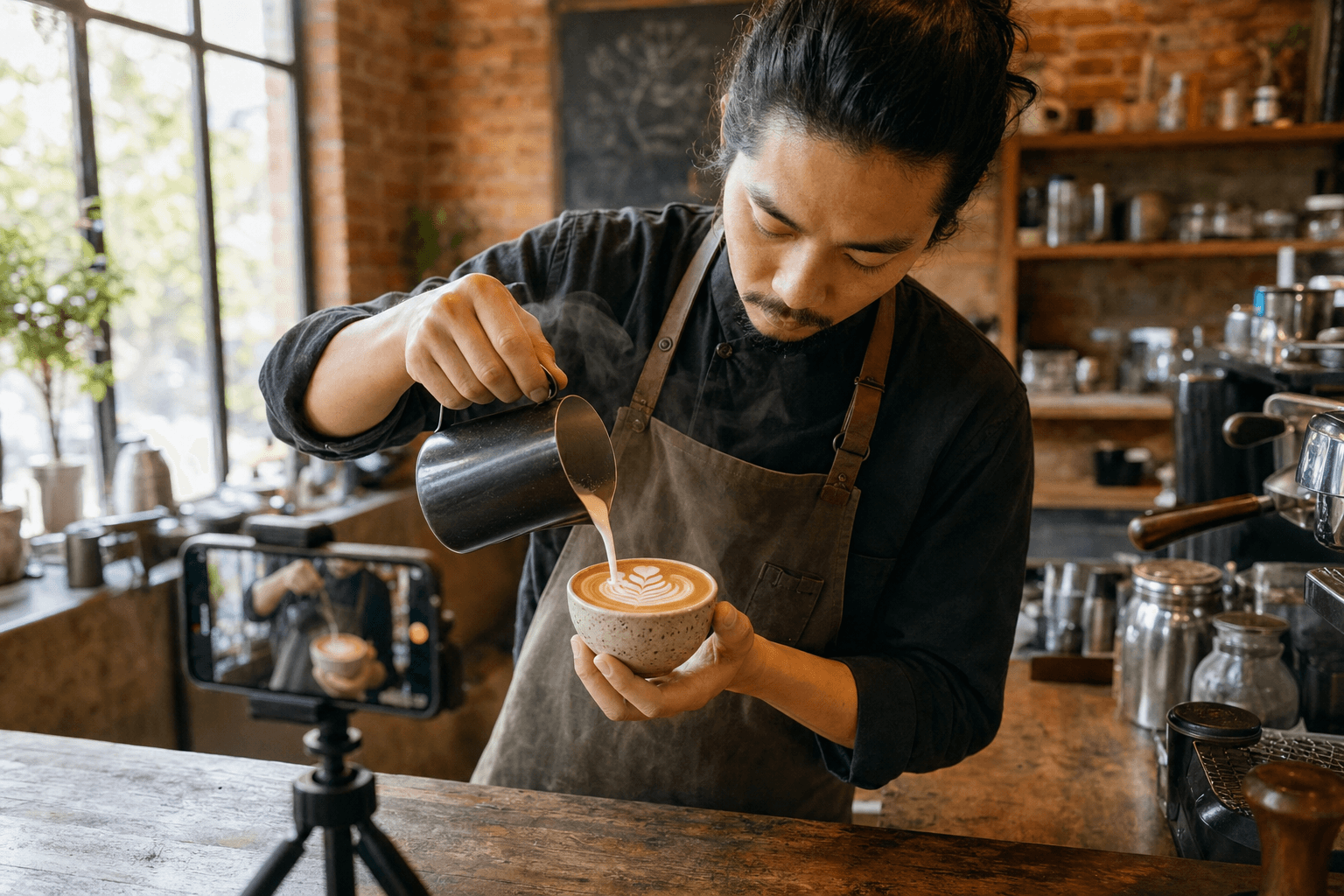
A 15-to-30-second video of a latte art pour, a V60 brew, or a cold brew being assembled is endlessly watchable. The key is getting close — fill the frame with the cup, the steam, the movement. No fancy camera needed; a modern smartphone propped on a small stand does the job. These perform especially well as Reels, TikToks, and YouTube Shorts.
Drink of the day reveals
When your cafe runs daily specials, a barista can do a quick, casual video introducing the drink — what's in it, why they like it, what it tastes like. This is far more compelling than a static post of the chalkboard. It also pairs perfectly with a digital menu that customers can check before they arrive.
Skill breakdowns
Short educational content — "here's why we pull our espresso at this temperature" or "here's the difference between a flat white and a latte" — positions your baristas as genuine experts and your cafe as a place that takes coffee seriously. This kind of content builds long-term trust and attracts coffee-curious customers who become your most loyal regulars.
Behind-the-scenes moments
Opening the cafe at 6am, dialing in a new single-origin, tasting a new seasonal syrup — these glimpses into the daily rhythm of your cafe are gold. They make followers feel like insiders. They humanize the brand in a way that a perfectly lit product shot never can.
Customer shoutouts (with permission)
A regular who orders the same drink every morning. A customer who just tried their first pour-over. These micro-stories, told with a quick video or a genuine caption, create community. Always get explicit permission before filming or naming a customer.
Equipping Your Baristas for Content Creation
You don't need a professional setup. But a few small investments make a real difference:
- A small phone tripod or clip mount. A $15-$25 flexible tripod that can be clamped to the espresso machine or bar edge frees up both hands for the pour.
- Good lighting. If your bar area is dark, a small ring light or a simple LED panel (under $40) transforms video quality instantly. Natural light from a nearby window is even better.
- A dedicated content corner. Designate a spot on the bar — a clean wooden surface, a branded cup, good light — as the default filming location. Consistency in the background helps build visual brand recognition.
- A shared folder for content. Set up a Google Drive or shared album where baristas can drop raw clips. This makes it easy for you to repost to the cafe's account with their permission.
Also consider linking your cafe's social bio to a well-designed menu page. When a video goes even mildly viral locally, curious viewers will visit your profile and look for your menu. Make sure what they find is clean and easy to navigate — a dedicated cafe menu page is far more effective than a PDF buried in a link tree.
Building a Loose Content Rhythm
You don't need a rigid editorial calendar. But a loose rhythm helps baristas know when content is expected and reduces the cognitive load of "what should I post today?"
A simple weekly structure might look like this:
- Monday or Tuesday: A new drink or seasonal special reveal
- Midweek: A process video or skill breakdown
- Friday or Saturday: A behind-the-scenes or community moment
This isn't a mandate — it's a suggestion. Some weeks a barista will post five things organically. Some weeks nothing gets posted. That's fine. The goal is a steady drip of genuine content over months, not a burst of forced posts.
Tie content moments to your menu updates. When you launch a new seasonal item, that's a natural content event. A barista introducing the drink, explaining the flavor profile, and showing it being made is far more effective than a static announcement post. If you're using a platform that makes it easy to update your QR code menu in real time, you can sync menu launches with content drops — the video goes live, the menu updates, and curious customers can check the new item before they arrive.
Amplifying Barista Content from the Cafe Account
Your baristas' personal posts are the seed. Your cafe's account is the amplifier. Here's how to get the most out of both:
Repost with credit
Always tag the barista when you repost their content. This respects their creative work, grows their following, and reinforces the idea that your cafe celebrates its people. It also signals to other baristas that participation gets recognition.
Stitch and respond
If a barista posts a skill video, the cafe account can respond with a follow-up — a customer reaction, a historical note about the technique, or a poll asking followers to vote on their favorite version. This creates a content conversation that extends the life of a single post.
Feature baristas in your bio and highlights
An Instagram highlight called "Meet the Team" with short intro videos from each barista does two things: it humanizes your brand for first-time visitors, and it gives your baristas a permanent showcase. First-time visitors often check this before deciding whether a cafe is "their kind of place."
Use their content on your menu and website
A great photo of a drink taken by a barista can become the hero image for that item on your digital menu. Authentic, in-context photography consistently outperforms studio shots for food and drink businesses. If your menu platform supports images, use them — it's one of the easiest ways to increase average order value.
Measuring What Actually Matters
Don't get lost in vanity metrics. A barista post with 400 views from local followers is worth more than a polished ad with 4,000 views from people who will never visit your neighborhood.
The metrics that matter for a local cafe content strategy:
- Profile visits and follows from local accounts. Check your Instagram insights for location data on new followers.
- Direct messages asking about a drink or special. This is a direct conversion signal — someone saw content and took action.
- Foot traffic on days after a post. Track whether certain content types correlate with busier mornings. It's not scientific, but patterns emerge.
- Menu page visits from social. If you have a digital menu with analytics, check whether social referral traffic spikes after content posts.
- New regulars mentioning social media. Train your baristas to casually ask new faces how they heard about the cafe. "I saw your barista on Instagram" is a data point worth tracking.
Avoiding Common Mistakes
A few pitfalls that derail otherwise good programs:
- Over-scripting. If you write the captions, choose the music, and direct the shots, you've removed everything that made it authentic. Give direction, not a script.
- Ignoring burnout. Content creation takes real mental energy. Check in with your baristas regularly. If someone wants to step back, let them.
- Inconsistent branding signals. Make sure your cafe's handle, location tag, and key hashtags are clearly communicated so content is consistently discoverable.
- Not updating your menu to match content. If a barista posts about a drink and a customer comes in asking for it, only to be told it's not available or the menu is out of date, that's a trust-breaker. Keep your online ordering page and menu current so content and reality stay aligned.
- Treating this as a campaign instead of a culture. The best behind-the-bar content programs aren't campaigns with start and end dates. They're ongoing expressions of a cafe culture where people are proud of their craft and happy to share it.
Frequently Asked Questions
Do my baristas need a large following for this to work?
No. Even a barista with 500 followers who are all local is more valuable for foot traffic than one with 10,000 followers spread across the country. Relevance and geography matter far more than raw follower count for a neighborhood cafe.
What if a barista leaves? Do we lose the content?
Any content they've created and shared with the cafe account remains yours to use (assuming you have their written permission). For their personal posts that tagged the cafe, those stay up as long as their account is active. This is one reason to always repost good content to the cafe's own account — it builds a library you control.
How do I handle a barista who posts something that reflects poorly on the cafe?
This is why clear written guidelines matter before anyone starts posting. If something problematic goes up, address it privately and promptly. In most cases, the issue is ambiguity — they didn't know something was off-limits. Clear guidelines prevent most problems before they happen.
Should I pay baristas extra for creating content?
It depends on the volume and quality of what you're asking for. If a barista is consistently creating high-quality content that drives real results, some form of compensation — even a small monthly bonus or free merchandise — is fair and keeps the program sustainable. Asking people to do marketing work for free indefinitely creates resentment.
What platforms should baristas focus on?
For most independent cafes, Instagram Reels and TikTok deliver the best organic reach for video content. If a barista already has an established presence on a specific platform, lean into that — their existing audience is more valuable than starting fresh somewhere new. The goal is authentic reach, not platform diversity.
Ready to make sure your cafe's online presence matches the quality of your content? Explore MenuHoster's cafe templates to build a digital menu and web presence that turns every new follower into a first-time visitor — and every first-time visitor into a regular. See our pricing and get set up in minutes, no tech skills required.
MenuHoster Team
Helping restaurants go digital