Digital Menu vs Printed Menu: Total Cost Comparison for Restaurants
Updated:
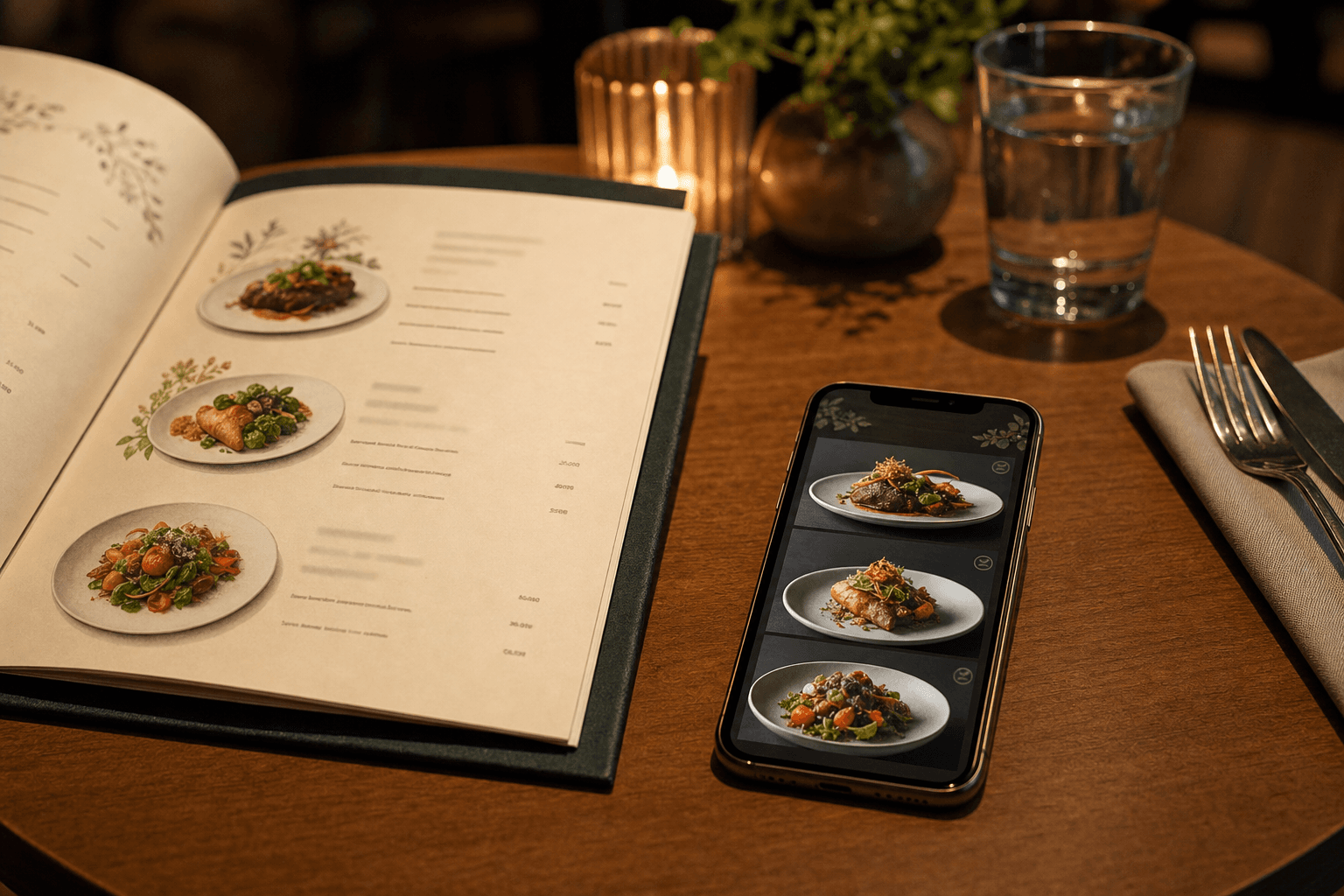
If you're still printing menus every time prices change or a dish gets 86'd, you already know the frustration. But how bad is it, really — in actual dollars? And does switching to a digital menu actually save money, or does it just trade one cost for another?
This article breaks down the true total cost of both options — printing and digital — over a one-year and three-year window. We'll look at design, production, updates, maintenance, and hidden costs that most comparisons skip. By the end, you'll have a clear picture of which format makes financial sense for your operation.
The True Cost of Printed Menus
Printed menus feel like a one-time expense. They're not. The costs stack up across four main categories: initial design, printing, reprints, and replacement due to damage or updates.
Initial Design
A professionally designed menu from a freelance graphic designer typically runs $300–$800 for a basic single-page or bi-fold layout. A multi-page booklet with custom photography can easily reach $1,500–$3,000. If you use an in-house template or a DIY tool, you save on design but spend time — and time has a cost too.
Printing Costs
Print pricing varies by quantity, paper stock, finish, and number of pages. Here are realistic ballpark figures for a standard 4-page (bi-fold) laminated menu:
- 50 menus: $180–$320 (~$3.50–$6.40 each)
- 100 menus: $280–$500 (~$2.80–$5.00 each)
- 200 menus: $420–$750 (~$2.10–$3.75 each)
Laminated or hard-cover menus cost significantly more — sometimes $8–$20 per unit — but they last longer. Unlaminated paper menus may need replacing every few months in a busy environment.
Reprints for Updates
This is where printed menus become expensive. Most independent restaurants update their menus at least 2–4 times per year — seasonal changes, price adjustments, supply issues, new dishes. Each update means a full reprint run. If you're spending $350 per print run and reprinting three times a year, that's $1,050/year just in reprints, not counting the original design.
Replacement Due to Wear and Damage
Even laminated menus get stained, torn, or lost. A 50-seat restaurant with 30 menus in circulation might replace 20–30% of its stock every year from normal wear. At $5 per menu, that's an extra $150–$450 annually — a cost that rarely shows up in anyone's budget.
Staff Time
Every menu update requires someone to coordinate with the printer, proof the file, place the order, and wait for delivery (often 5–10 business days). That's a few hours per update cycle. At a manager's hourly rate of $20–$25, three update cycles per year adds another $120–$300 in labor.
Printed Menu: Estimated Annual Cost Summary
- Initial design (amortized over 1 year): $300–$800
- Initial print run: $280–$500
- 2–3 reprint runs: $560–$1,500
- Replacement/damage: $150–$450
- Staff coordination time: $120–$300
- Total Year 1: ~$1,410–$3,550
- Total Year 2–3 (ongoing, no redesign): ~$830–$2,250/year
The True Cost of a Digital Menu
A digital menu has a different cost structure: lower upfront, predictable ongoing subscription, and near-zero update costs. Here's how the numbers break down.
Setup and Design
Most digital menu platforms — including MenuHoster — offer pre-built templates that eliminate the need for a professional designer. Setup time for a typical restaurant menu is 1–3 hours for the owner or a staff member. If you want a custom-designed look, some platforms charge a one-time setup fee, but many do not.
If you already have a PDF menu, you can use a PDF-to-QR-code menu tool to get online in minutes with no redesign required. That's a $0 design cost to get started.
Platform Subscription
Digital menu platforms typically charge a monthly or annual subscription. Pricing across the market generally falls into these tiers:
- Free plans: Available on some platforms with limited menus or branding restrictions
- Entry-level paid plans: $10–$25/month (1–3 menus, basic features)
- Mid-tier plans: $25–$60/month (multiple menus, ordering features, analytics)
- Full-featured plans: $60–$120/month (online ordering, integrations, custom domain)
For most independent restaurants, a mid-tier plan at around $30–$50/month ($360–$600/year) covers everything they need. Check MenuHoster's pricing to see current plan details.
QR Code Materials
You'll need to place QR codes somewhere guests can scan them — table tents, stickers, or inserts. This is a one-time or occasional cost:
- Printed QR code table tents (50 units): $40–$120
- QR stickers (100 units): $15–$40
- Replacement/reorder (annual): $20–$60
Unlike your full menu, QR codes don't need to be reprinted when your menu changes — the URL stays the same. That's a significant structural advantage.
Update Costs
This is the biggest financial difference. With a digital menu, updating a price, swapping a dish, or adding a seasonal special takes 2–5 minutes and costs nothing extra. No reprint, no delivery wait, no coordination. Over a year with four update cycles, you're saving hours of labor and hundreds of dollars in print costs.
Digital Menu: Estimated Annual Cost Summary
- Setup/design time (one-time, amortized): $0–$150
- Platform subscription: $360–$600/year
- QR code materials (initial): $55–$160
- QR code replacement (annual): $20–$60
- Update labor: ~$0–$30 (minutes per update)
- Total Year 1: ~$435–$1,000
- Total Year 2–3 (ongoing): ~$380–$660/year
Side-by-Side: Three-Year Cost Comparison
Let's put these numbers together for a typical 40–60 seat independent restaurant that updates its menu three times per year and maintains 30–40 physical menus in circulation.
- Printed menu — Year 1: ~$2,200
- Printed menu — Year 2: ~$1,400
- Printed menu — Year 3: ~$1,400
- Printed menu — 3-year total: ~$5,000
- Digital menu — Year 1: ~$700
- Digital menu — Year 2: ~$500
- Digital menu — Year 3: ~$500
- Digital menu — 3-year total: ~$1,700
The three-year savings: approximately $3,300. That's not a rounding error — it's real money that can go toward food costs, staffing, or marketing.
Costs That Don't Show Up in the Spreadsheet
Pure dollar figures don't capture everything. Here are a few less-obvious factors that affect the real-world value of each format.
Menu Accuracy and Guest Experience
Printed menus go stale between reprints. Guests order items that are out of stock. Prices on the menu don't match the POS. Staff spend time explaining discrepancies. These friction points are hard to quantify, but they erode trust and slow down service. A digital menu is always current — the moment you update it, every guest sees the change.
Hygiene Perceptions
Post-pandemic, a meaningful segment of diners still prefers not to handle shared physical menus. A QR-based digital menu removes that friction entirely. Whether or not you personally think it matters, some guests do — and their comfort affects their experience and likelihood of returning.
SEO and Discoverability
A well-structured digital menu that lives at a public URL can be indexed by Google. That means your menu items, prices, and descriptions can surface in search results when someone searches for "best pasta near me" or "restaurants with gluten-free options downtown." A printed menu contributes nothing to your online discoverability. This is a real, ongoing value that's easy to overlook.
Online Ordering Integration
Many digital menu platforms — including MenuHoster — allow you to add online ordering directly to your menu page. That's a revenue channel that a printed menu simply cannot offer. Even if you don't use it on day one, having the option without switching platforms is worth something.
Analytics
Digital menus can tell you which items get viewed most, what time of day guests browse, and which sections they skip. That data is genuinely useful for menu engineering and pricing decisions. Printed menus give you nothing.
When Printed Menus Still Make Sense
This article isn't arguing that printed menus are always wrong. There are situations where they still have a role:
- Fine dining establishments where a physical, tactile menu is part of the experience and brand positioning. In this case, the menu is a designed object, not just an information delivery tool.
- Guests with limited smartphone access — elderly diners or areas with poor mobile coverage. A hybrid approach (QR code + a few printed backups) handles this without full printing costs.
- Specials boards and table cards for simple, limited offerings that don't change often.
For most independent restaurants, the right answer is a hybrid model: a digital menu as the primary format, with a small number of printed backups available on request. This captures the cost savings of digital while preserving accessibility for all guests.
How to Make the Switch Without Disruption
Switching from printed to digital doesn't require a big project. Here's a practical sequence:
- Choose a platform and set up your menu. Use an online menu maker with pre-built templates to get your menu live in an afternoon.
- Generate your QR code and test it on multiple devices before printing anything.
- Order table tents or stickers — simple, inexpensive, and reusable regardless of menu changes.
- Brief your staff on how to explain the QR menu to guests and what to say if someone prefers a physical menu.
- Keep 5–10 printed menus on hand for guests who request them, but stop doing full reprint runs.
- Update your digital menu whenever prices or items change — it takes minutes.
Most restaurants that make this switch report that within two to three weeks, the majority of guests are using the digital menu without any prompting or complaints.
Frequently Asked Questions
How much does it cost to print menus for a restaurant?
For a standard 4-page laminated menu, expect to pay $2.50–$6.50 per unit for runs of 50–200 copies. Hard-cover or premium menus can cost $8–$20 each. Factor in 2–4 reprint runs per year and the annual cost for a typical restaurant is $800–$2,500 in printing alone, before design or labor.
Are digital menus cheaper than printed menus?
Yes, significantly, over any period longer than a few months. A digital menu platform typically costs $360–$600 per year. Printed menus for the same restaurant often cost $1,400–$2,500 per year when you include reprints and replacements. The savings compound over time because digital update costs are essentially zero.
Do customers actually use QR code menus?
Adoption varies by demographic and location, but QR code menu usage has become mainstream in most markets since 2020. Surveys consistently show that the majority of diners under 50 are comfortable with QR menus, and even older demographics have largely adapted. Offering a small number of printed backups handles the minority who prefer physical menus.
What happens if a customer doesn't have a smartphone?
Keep 5–10 printed menus available for guests who request one. This hybrid approach costs very little — you're not doing full reprint runs, just maintaining a small backup stock — and ensures no guest is turned away or inconvenienced.
Can a digital menu help my restaurant show up in Google searches?
Yes. A digital menu hosted at a public URL can be indexed by search engines. If your menu page includes well-written item descriptions and is connected to your Google Business Profile, it can improve your visibility in local search results. A printed menu has no SEO value whatsoever.
Ready to stop paying for reprints every time your prices change? MenuHoster makes it easy to build a professional digital menu, generate a QR code, and keep everything updated in minutes — no designer or developer needed. See our plans and start your free trial today.
MenuHoster Team
Helping restaurants go digital