How to Upsell Salon Add-On Services Without Being Pushy
Updated:
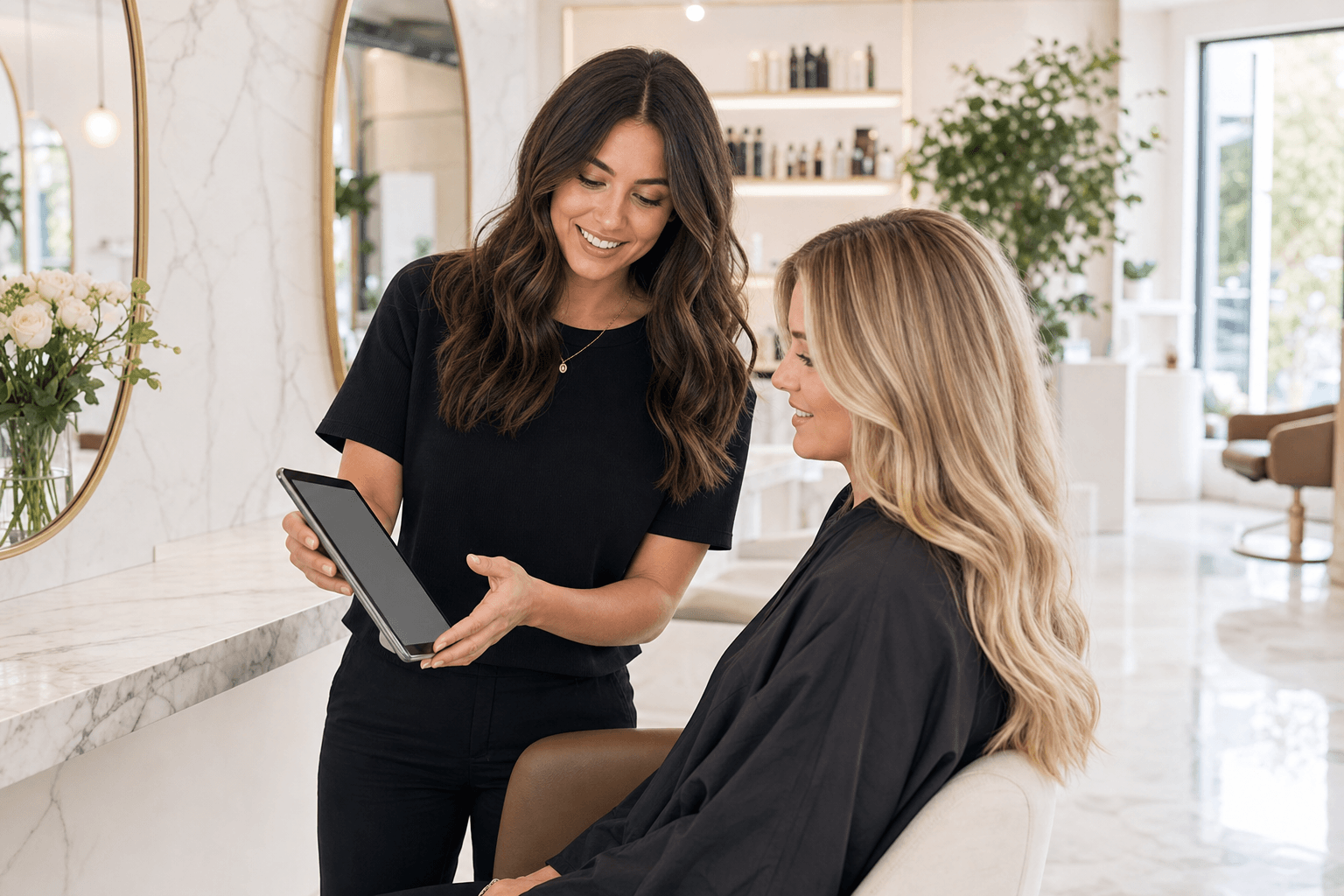
Upselling has a bad reputation it doesn't fully deserve. Done right, it isn't about squeezing more money out of clients — it's about making sure they leave with exactly what they came for, plus anything that genuinely improves their result. The difference between pushy and helpful is almost entirely about timing, framing, and context.
This guide gives you concrete, tested techniques for introducing add-on services at your salon, barbershop, nail salon, or spa in a way that feels natural to clients and consistent to your whole team. No scripts that sound like a car dealership. No guilt-tripping. Just practical methods that grow your average ticket while keeping clients happy to come back.
Why Add-Ons Matter for Salon Revenue
Labor is your biggest cost, and your chairs are your inventory. Once a client is seated, the fixed cost of that appointment — your time, the utilities, the booking overhead — is already spent. Adding a $15 deep-conditioning treatment or a $20 brow wax to an existing appointment doesn't double your costs; it adds almost pure margin.
Consider the math: if you do 25 appointments a week and convert just 30% of them into a $20 add-on, that's $150 extra per week, roughly $7,800 per year — without a single new client. Scale that across a two- or three-chair salon and the impact is significant.
The key insight is that clients who are already in your chair are the easiest people to sell to. They've already decided to spend money with you. They trust you. They're relaxed. The only thing standing between you and that upsell is how you present it.
Start With the Right Add-Ons
Not every service makes a good add-on. The best candidates share a few traits:
- Short duration: 10–20 minutes max. Anything longer needs to be booked as its own appointment.
- Logical pairing: It should feel like a natural extension of what the client is already getting. A scalp massage pairs with a shampoo. A cuticle treatment pairs with a manicure. A beard trim pairs with a haircut.
- Visible results: If the client can feel or see the difference before they leave, they'll associate the add-on with a better outcome and be more likely to book it again.
- Easy to deliver consistently: Your whole team needs to be able to execute it the same way every time.
Common high-performing add-ons by business type:
- Hair salons: Deep conditioning, gloss treatment, scalp massage, toner refresh, bang trim
- Barbershops: Hot towel shave, beard trim, scalp treatment, eyebrow cleanup
- Nail salons: Gel upgrade, nail art, paraffin wax dip, cuticle treatment, extended massage
- Spas: Aromatherapy upgrade, eye treatment, lip treatment, extended massage time, hot stone add-on
Once you've identified your top three to five add-ons, make sure they're clearly listed — with a short description and price — on your digital salon menu. Clients who can browse your services before or during their appointment are far more likely to ask about add-ons themselves, which removes the awkwardness entirely.
The Consultation Is Your Best Upsell Window
The single most natural moment to introduce an add-on is during the pre-service consultation — not after you've already started, and not at checkout when the client just wants to leave.
During the consultation, you're already asking questions about what the client wants. That conversation gives you genuine, observation-based reasons to suggest something extra. The key word is observation-based. You're not reciting a menu; you're responding to what you actually see.
Use "I noticed" language
Compare these two approaches:
- "Would you like to add a deep-conditioning treatment today?" — Generic. Sounds like a script.
- "I noticed your ends are a little dry — probably from the weather. A 10-minute conditioning treatment would make a real difference today. It's only $18. Want me to add it in?" — Specific, relevant, honest.
The second version works because it gives the client a reason. It connects the add-on to something real about their hair or skin. It also removes the guesswork — you're telling them the price upfront so there's no anxiety about what it will cost.
Ask once, clearly, then accept the answer
Mention the add-on once during the consultation. If the client says no, acknowledge it and move on. Don't loop back to it. Don't ask again at checkout. Respecting a "no" is what makes clients comfortable saying "yes" the next time, because they know you won't push.
Use Your Menu as a Silent Salesperson
One of the most effective ways to upsell without any verbal pressure is to let your menu do the work. When clients can browse your services on their own — while waiting, while their color processes, while their nails dry — they often discover add-ons they didn't know existed and ask about them unprompted.
A printed menu behind the reception desk doesn't achieve this. A digital menu on a tablet at the station, or accessible via a QR code, puts the information directly in front of the client at the right moment.
A few things that make a digital menu more effective at driving add-ons:
- Group add-ons visually near their parent service. If "Gloss Treatment" appears right below "Color Service," clients naturally consider it as a pair.
- Write short benefit-focused descriptions. "Adds shine and seals color — lasts 4–6 weeks" is more persuasive than "Gloss treatment."
- Show the price clearly. Hiding prices creates anxiety. Transparency builds trust.
- Use a QR code at the station. Clients waiting for color to process have nothing to do. A QR code menu gives them something useful to browse — and plants the seed for future bookings.
Train Your Team to Upsell Consistently
If upselling only happens when a particular stylist feels like it, your results will be inconsistent and your clients will have uneven experiences. A simple, team-wide approach removes that variability.
Create a short upsell checklist per service
For each core service, identify one or two relevant add-ons and build them into the consultation flow. For example:
- Haircut → check scalp condition → mention scalp treatment if relevant
- Color → check hair texture → mention gloss or conditioning treatment
- Manicure → check cuticles → mention cuticle treatment or paraffin
This isn't about forcing a script. It's about making sure every client gets the same quality of consultation, and no add-on gets forgotten just because the stylist was busy.
Practice the language together
Role-play the consultation in a team meeting. Have stylists practice the "I noticed" framing until it feels natural. The goal is for the suggestion to sound like professional advice, not a sales pitch — because that's exactly what it is.
Track what's working
Keep a simple log of which add-ons are being sold, by whom, and at what rate. If one stylist is converting 40% of clients on conditioning treatments and another is at 5%, that's a coaching conversation waiting to happen — and a best practice waiting to be shared.
Package Add-Ons to Reduce Decision Fatigue
Another low-pressure way to increase add-on revenue is to bundle services into packages. When a client books a "Signature Color Service" that already includes a gloss treatment and a blow-dry, they don't experience it as an upsell at all — it's just what they booked.
Packages work well because:
- They make the decision once (at booking) rather than in the chair
- They feel like value, not pressure
- They increase average ticket without any in-appointment sales conversation
When building packages, anchor the price slightly below what the services would cost individually. A $95 package that would cost $110 à la carte feels like a deal, even if the client only wanted one of the included services.
Make sure your packages are easy to find and understand on your salon services menu. A confusing package structure — too many options, unclear inclusions — will kill conversions faster than no packages at all.
Use the Booking Confirmation to Plant the Seed
Your appointment confirmation message is an underused upsell channel. When a client books a haircut, your confirmation text or email can mention a relevant add-on — not as a hard sell, but as useful information.
Something like: "Your appointment is confirmed for Saturday at 2pm. Did you know we also offer a 15-minute scalp treatment that pairs well with your cut? Ask your stylist about it when you arrive."
This approach works because:
- The client has time to think about it before they arrive
- It doesn't feel like pressure — it's information, not a sales pitch
- When the stylist mentions it during consultation, it's not the first time the client has heard about it
For more on how to write appointment messages that clients actually appreciate, see our guide on salon email and text reminders that clients appreciate.
Handle Price Objections Without Backing Down
Sometimes a client will hesitate because of price. That's fine — but it doesn't mean you should immediately offer a discount or apologize for the cost. Instead, briefly reinforce the value and let the client decide.
If a client says "That seems like a lot for a conditioning treatment," a good response is: "It's $18 and takes about 10 minutes. The difference in how your hair feels and looks when you leave is pretty noticeable — especially with how dry your ends are right now. But totally up to you."
That response does three things: it restates the price clearly, it connects the cost to a specific benefit, and it gives the client autonomy. You're not caving, but you're not pressuring either.
Loyalty Programs and Add-Ons Work Together
If you run a loyalty program, add-ons are a natural fit. Consider giving points for add-on purchases, or offering a free add-on as a loyalty reward. This creates a positive association with trying new services — and once a client has experienced a treatment they love, they often start booking it regularly.
For ideas on building a loyalty structure that keeps clients coming back, check out our guide on salon loyalty and membership ideas that retain clients.
What Not to Do
A few common mistakes that make upselling feel pushy — and how to avoid them:
- Don't ask at checkout. The client's mind is on leaving. Suggesting an add-on after the service is over feels like an afterthought at best and a shakedown at worst.
- Don't suggest multiple add-ons at once. Pick the one most relevant to this client, this visit. Listing five options feels like a menu recitation, not a recommendation.
- Don't tie the add-on to a problem the client didn't ask about. If someone comes in for a trim and their hair looks healthy, don't manufacture a problem to sell a treatment. Clients notice, and it erodes trust.
- Don't apologize for the price. Saying "it's only $15" or "it's not that expensive" signals that you're not confident in the value. State the price plainly.
- Don't make the client feel bad for saying no. A slight frown or a "are you sure?" after a declined add-on is enough to make a client dread the consultation next time.
Frequently Asked Questions
How many add-ons should I offer at my salon?
Three to six well-chosen add-ons is usually the sweet spot. Too few and you're leaving revenue on the table; too many and clients get overwhelmed. Focus on add-ons that pair naturally with your most popular services and that your team can deliver consistently.
Should I train all my stylists to upsell, or just senior staff?
Everyone on the floor should be comfortable suggesting relevant add-ons during the consultation. Junior stylists may need more coaching on the language, but the behavior should be consistent across the team. Inconsistency leads to uneven client experiences and makes it hard to measure what's working.
Is it better to include add-ons in packages or offer them à la carte?
Both approaches work, and they complement each other. Packages capture clients who prefer simplicity and make decisions at booking. À la carte add-ons capture clients who prefer to customize. Offering both gives you the widest coverage.
How do I introduce a new add-on service to existing clients?
Mention it during the consultation for clients who would genuinely benefit from it, and include it in your next booking confirmation or email newsletter. You can also offer a limited-time introductory price to encourage first-time tries. Once a client has experienced it, they're much more likely to book it again at full price.
Can a digital menu really help with upselling?
Yes — significantly. When clients can browse your full service list on their own, they often discover add-ons they didn't know you offered and ask about them without any prompting from your team. A well-organized digital menu with clear descriptions and prices reduces friction and does a lot of the selling passively.
Ready to put your services and add-ons in front of clients in the most effective way possible? Browse MenuHoster's salon menu templates and launch a polished digital menu in minutes — no design skills or web developer needed. It's one of the easiest changes you can make to start growing your average ticket today.
MenuHoster Team
Helping restaurants go digital