Cafe Email and SMS Marketing That Respects Customers
Updated:
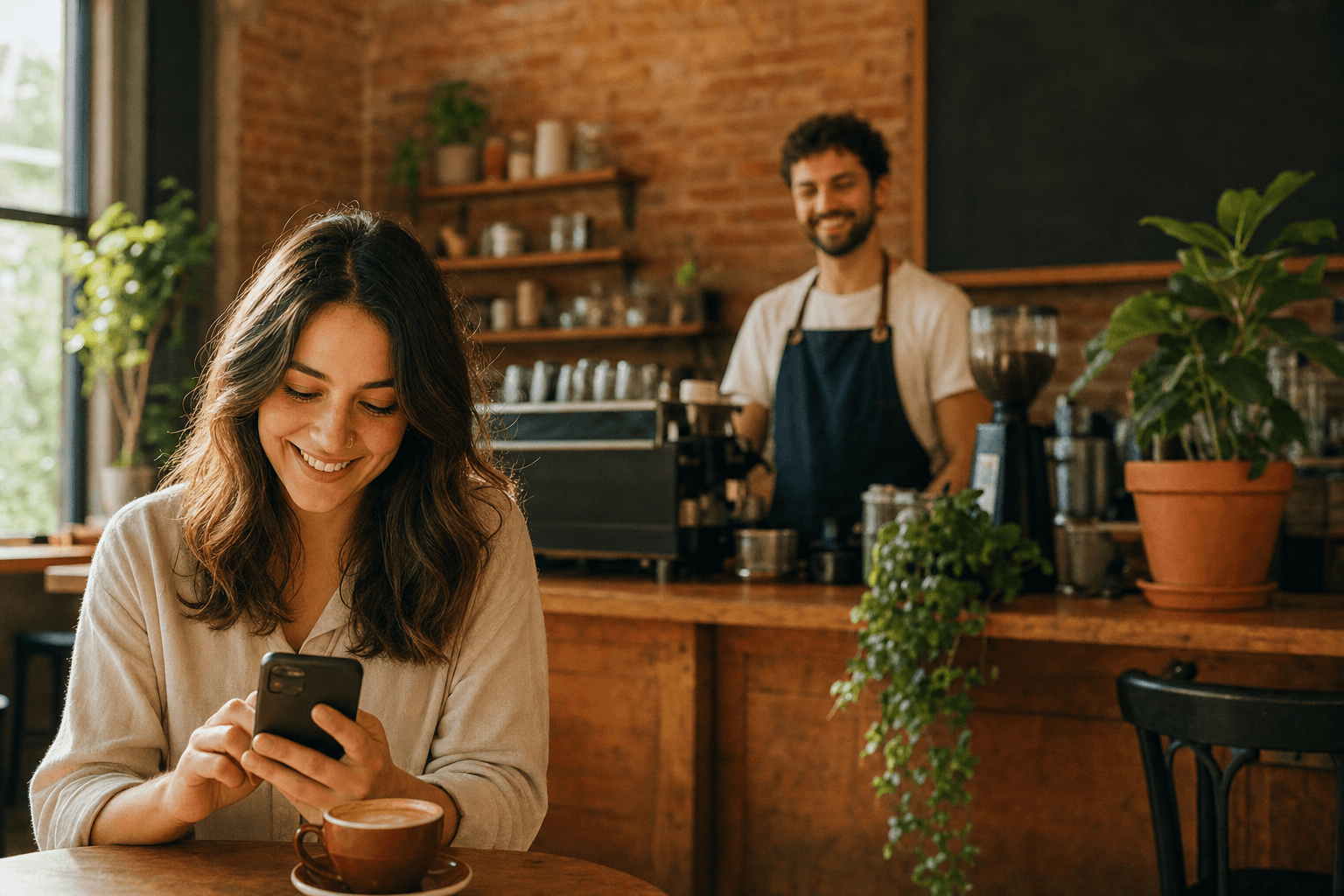
Chains have massive marketing budgets. They can afford to blast millions of people with promotions and accept that most recipients will ignore them. As an independent cafe owner, you can't compete on volume—but you can absolutely win on relevance and trust.
Email and SMS marketing, done right, are two of the highest-return channels available to small businesses. Done wrong, they destroy the very thing that makes an independent cafe special: the feeling that this place actually knows and cares about you. This guide is about doing it right.
Why Email and SMS Still Work for Cafes
Social media algorithms are unpredictable. You can spend hours crafting a post and have it reach 3% of your followers. Email and SMS are different—messages land directly in someone's inbox or pocket, and open rates reflect it. The average email open rate across industries hovers around 35–40%; SMS open rates regularly exceed 90%, often within minutes of delivery.
More importantly, the people on your list chose to be there. That opt-in is a signal of genuine interest. A customer who hands over their email or phone number is telling you they want a relationship beyond the transaction. That's a gift—treat it like one.
For cafes specifically, these channels shine in a few key scenarios:
- Announcing a seasonal drink or new menu item before it sells out
- Filling slow mornings with a timely, limited offer
- Rewarding regulars with early access or exclusive perks
- Staying top-of-mind during weeks when a customer hasn't visited
Permission Is Everything
The word "respects" in this article's title is not decoration. Permission-based marketing isn't just a legal requirement under CAN-SPAM, TCPA, and GDPR—it's the foundation of whether your messages are welcomed or resented.
Never add someone to a list without explicit consent. That means:
- No importing contacts from your personal phone
- No adding emails collected for a different purpose (a catering inquiry, for example)
- No pre-checked opt-in boxes on forms
Instead, make the value proposition clear at the point of sign-up. "Get our seasonal drink announcement before anyone else" is far more compelling—and honest—than "Join our mailing list." Tell people roughly how often you'll contact them and what they'll receive. Then deliver exactly that.
Where to collect sign-ups
- At the counter — a small card or tablet prompt at checkout, tied to a loyalty reward
- On your QR menu — a subtle opt-in link at the bottom of your digital cafe menu
- On your website or ordering page — a simple embedded form, not a pop-up that fires after two seconds
- Via a loyalty program sign-up — the most natural exchange: contact details for points or perks
- On social media — link to a sign-up page in your bio, but don't make it the only thing you ever post
Building Your Email List the Right Way
A list of 300 genuinely interested regulars will outperform a list of 3,000 indifferent contacts every single time. Focus on quality from day one.
Choose a simple platform
You don't need enterprise software. Mailchimp's free tier handles up to 500 contacts. Klaviyo, Brevo (formerly Sendinblue), and Omnisend all have affordable plans for small businesses. Pick one with a drag-and-drop editor, basic automation (welcome email, birthday message), and clean analytics. Don't overthink the tool—the content matters far more.
Set up a welcome sequence
When someone joins your list, send a welcome email within minutes. This is your highest-open email—ever. Use it to:
- Confirm what they signed up for
- Deliver any promised reward (a discount code, a free pastry offer)
- Briefly introduce your cafe's story or values in 2–3 sentences
- Tell them what to expect next
Keep it short. One clear call to action. No wall of text.
Cadence: less is more
For most independent cafes, two to four emails per month is the sweet spot. One or two "news" emails (new menu items, events, seasonal specials) and one or two "value" emails (a recipe tip, a behind-the-scenes story, a staff spotlight) per month keeps you present without becoming noise. If you only have something genuinely useful to say once a month, send once a month. An unsubscribe is almost always triggered by irrelevance or frequency—fix both.
What to Actually Write
The biggest mistake cafe owners make with email is treating it like a flyer. "20% OFF THIS WEEKEND ONLY" in a giant font, repeated three times. Customers see through it, and it trains them to ignore you.
Instead, write like a person who runs a cafe they're proud of. Here's a framework that works:
The story + offer structure
Lead with something human. Two or three sentences about why you're introducing a new drink, where the beans came from, or what inspired a menu change. Then make the offer. The story gives the offer context and credibility. It also makes the email worth reading even if the recipient doesn't act on the promotion.
Subject lines that earn the open
Avoid clickbait. "You won't believe our new latte" is a broken promise before the email even opens. Try specificity instead: "Our fall apple cardamom latte is back — Friday only" or "We interviewed our head roaster. Here's what she said." Specificity signals that there's something real inside.
One clear action per email
Every email should have one primary call to action. View the seasonal menu. Claim your birthday reward. Book a table for the weekend pop-up. Multiple competing links dilute attention. If you link to your digital menu, make sure it's updated and mobile-friendly before the email goes out.
Segment when you can
Even basic segmentation dramatically improves relevance. If your platform supports it, separate customers who've opted into a loyalty program from general subscribers. Send loyalty members early access. Send general subscribers a "here's what you missed" follow-up. Over time, you can also segment by visit frequency or purchase behavior if your point-of-sale system integrates with your email tool.
SMS Marketing: The Higher-Stakes Channel
Text messaging is intimate. It sits in the same thread as messages from family and friends. That proximity is exactly why SMS works—and exactly why it must be handled with more care than email.
The rules are stricter
In the US, the Telephone Consumer Protection Act (TCPA) requires written consent before sending marketing texts. "Written" includes a digital opt-in form, but it must be explicit: "By entering your number, you agree to receive marketing texts from [Cafe Name]. Message and data rates may apply. Reply STOP to unsubscribe." Use a compliant SMS platform—SimpleTexting, Attentive, EZTexting, or Postscript are popular options—that handles opt-out management automatically. Non-compliance carries serious fines.
Frequency: even lower than email
Two to four SMS messages per month is a ceiling, not a target. Most cafes do well with one or two per month. Reserve texts for genuinely time-sensitive, high-value messages: a flash sale that expires today, a pop-up event happening this weekend, a limited batch that's almost gone. If you're sending a text, ask yourself: "Would I be glad to receive this?" If the answer is uncertain, don't send it.
Keep it short and direct
SMS is not the place for storytelling. Get to the point in the first sentence. Include the offer, the deadline, and one link. Example: "Our single-origin Ethiopian pour-over is back — only 20 bags. Grab yours before noon: [link]." That's it. No emojis for the sake of emojis. No exclamation marks on every sentence.
Make opting out effortless
Every SMS must include a clear opt-out instruction ("Reply STOP to unsubscribe"). Make it easy. A customer who can't opt out easily doesn't become a loyal regular—they become someone who blocks your number and leaves a bad review. Honor opt-outs immediately and permanently.
Combining Email and SMS Without Overwhelming People
If a customer is on both your email list and your SMS list, you need a strategy to avoid double-messaging them about the same thing. A few principles:
- Use SMS for urgency, email for depth. The seasonal menu launch gets an email with the story and photos. The "last 48 hours" reminder gets a text.
- Don't send both on the same day for the same promotion unless there's a compelling reason. It reads as desperation.
- Let customers choose their preference. On your sign-up form, let people opt into email, SMS, or both. Respecting that choice builds trust immediately.
Measuring What Matters
Don't obsess over vanity metrics. Here's what actually tells you something useful:
- Open rate — Are your subject lines working? Below 25% for email is a warning sign.
- Click-through rate — Are people engaging with your content and offers?
- Unsubscribe rate — A spike after a specific campaign tells you it missed the mark.
- Redemption rate — How many people actually used the offer? This is the real revenue signal.
- List growth rate — Are you consistently adding new subscribers, or is the list shrinking?
Review these numbers monthly, not daily. Look for trends over time rather than reacting to individual sends. If open rates are declining, try varying your subject line style. If click-through is low, simplify your call to action. If unsubscribes spike, reduce frequency or improve relevance.
Connecting Your Marketing to Your Menu
Your email and SMS campaigns are only as good as what they point to. If you send a beautifully written email about your new autumn drinks and the link leads to a slow, outdated PDF menu, you've broken the chain. Every marketing message should link to a fast, mobile-optimized page that reflects exactly what you described.
This is where a QR code menu or a hosted digital menu earns its keep. You can update your menu in real time—add a new item, mark something as sold out, adjust a price—and every link you've ever sent will reflect the current version. No reprinting, no broken links, no customer arriving to find the item you promoted is no longer available.
If you also offer online ordering, connect your campaigns directly to your order page. "Order ahead for Saturday morning pickup" with a direct link removes every barrier between the email and the purchase.
The Trust Account Analogy
Think of your relationship with each subscriber as a trust account. Every useful, relevant, well-timed message makes a deposit. Every irrelevant blast, every overly promotional text, every message that arrives too soon after the last one makes a withdrawal. Run the account to zero and they unsubscribe. Run it negative and they tell a friend.
The cafes that build genuinely loyal followings through email and SMS are the ones that treat every message as an opportunity to add value—not just to extract a purchase. Sometimes that means sending fewer messages. Sometimes it means sharing something interesting with no offer attached at all. That restraint is what makes the promotional messages land when you do send them.
Frequently Asked Questions
How do I get my first 100 email subscribers as a new cafe?
Start with your loyalty program sign-up—it's the most natural exchange of contact details for value. Add a sign-up prompt to your digital menu and your Google Business Profile. Ask staff to mention it at checkout for the first few weeks. A small incentive (a free drink on your next visit, a pastry discount) can accelerate early growth without cheapening your brand. Focus on making the first email so good that subscribers tell a friend.
Is SMS marketing worth the cost for a small independent cafe?
Yes, if you use it selectively. SMS platforms typically charge per message or a flat monthly fee starting around $20–$30/month. Even a small list of 200 engaged subscribers who redeem a monthly offer can easily justify that cost. The key is not overusing the channel—if you send too many texts, people opt out and the investment is wasted. One or two high-value texts per month, consistently, will outperform weekly blasts every time.
What's the best time to send cafe marketing emails?
For cafes, Tuesday through Thursday mornings (7–10am local time) tend to perform well—people are in a coffee-oriented mindset and checking their phones. For a weekend promotion, send the email Thursday or Friday morning so people can plan. For SMS, avoid early morning (before 9am) and late evening (after 8pm) out of basic courtesy. Test different times with your own audience and let the data guide you after a few months.
How do I handle unsubscribes without taking it personally?
Unsubscribes are normal and healthy. Someone leaving your list doesn't mean they dislike your cafe—it often just means their circumstances changed or the frequency wasn't right for them. A clean, engaged list is more valuable than a large, disengaged one. Honor every opt-out immediately, never re-add someone who unsubscribed, and focus your energy on the people who stay. A 1–2% unsubscribe rate per campaign is within normal range; anything higher warrants a look at your content and frequency.
Do I need separate consent for email and SMS?
Yes. Consent for email does not cover SMS, and vice versa. You need separate, explicit opt-ins for each channel. Most compliant sign-up forms have distinct checkboxes: one for email marketing and one for SMS/text marketing. This also gives customers the choice to opt into only one channel, which respects their preferences and typically results in higher engagement from those who do sign up.
Ready to make sure every marketing message you send points to a menu and ordering experience that actually converts? MenuHoster's cafe menu tools let you build a fast, beautiful, always-current digital menu in minutes—no developer needed. Check out our pricing plans and start turning your marketing into real visits today.
MenuHoster Team
Helping restaurants go digital