Local SEO for Salons and Barbershops: A Practical Guide
Updated:
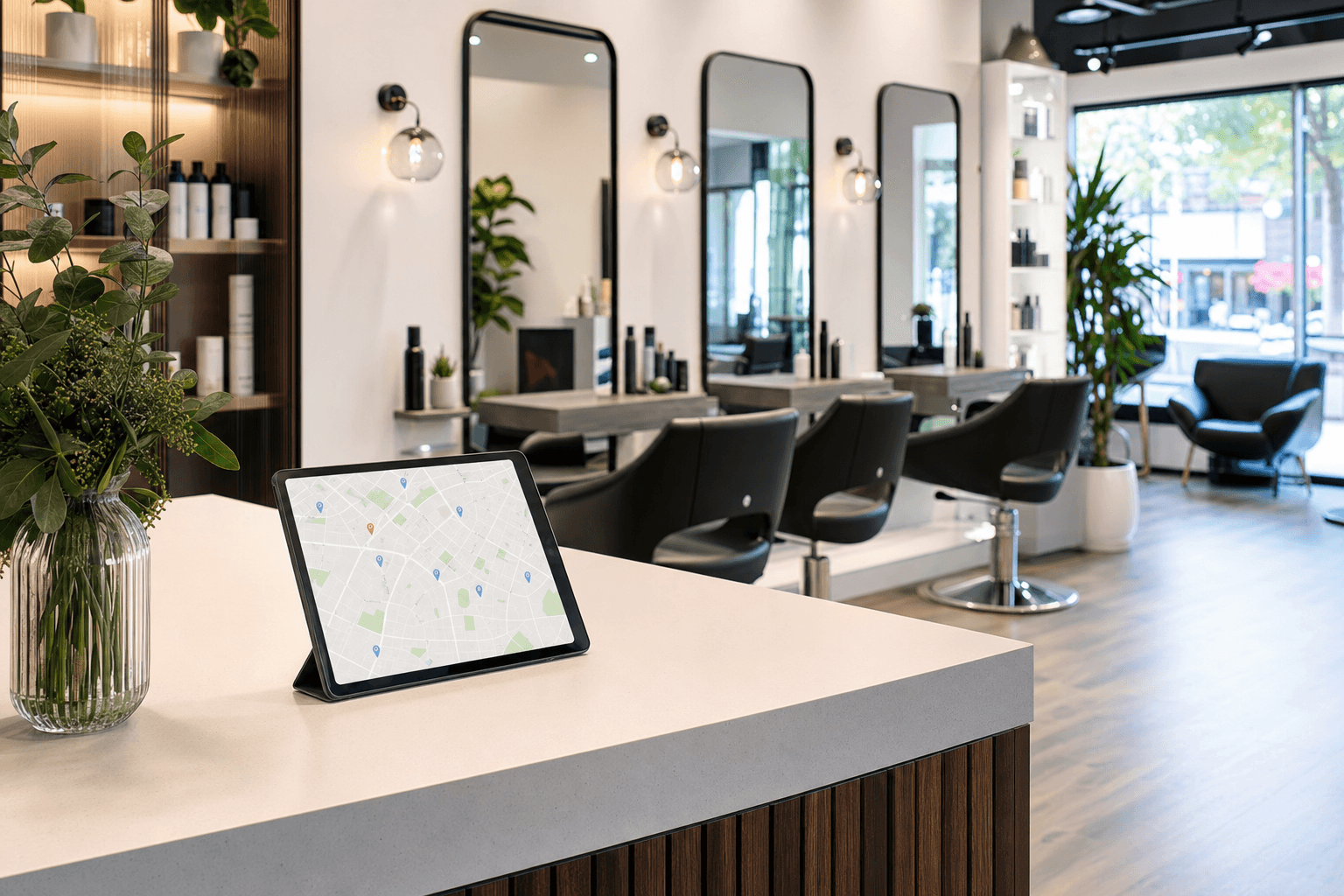
When someone in your neighborhood types "haircut near me" or "best nail salon in [city]" into Google, your business either shows up or it doesn't. That's local SEO in a nutshell — and for salons and barbershops, it's one of the highest-return marketing activities you can do. Unlike paid ads, the work you put in compounds over time. Unlike social media, you're reaching people who are actively looking to book right now.
This guide walks you through every meaningful lever you can pull, in priority order, without wasting your time on tactics that don't move the needle for local service businesses.
Why Local SEO Is Different for Salons
Most SEO advice is written for e-commerce stores or content sites trying to rank nationally. Salons operate in a radius of a few miles. Your goal isn't to outrank every salon in the country — it's to dominate the "Local Pack" (the map results with three listings that appear at the top of a Google search) and the organic results for your city or neighborhood.
Google uses three main factors to decide which local businesses rank:
- Relevance: Does your business match what the searcher is looking for?
- Distance: How close is your business to the searcher?
- Prominence: How well-known and trusted is your business online?
You can't control distance. You can absolutely control relevance and prominence. That's where this guide focuses.
Google Business Profile: Your Most Important Asset
Your Google Business Profile (GBP) is the single most impactful thing you can optimize for local search. It's free, and most salons leave it half-finished.
Claim and verify your listing
Go to business.google.com and claim your listing if you haven't already. Google will send a postcard with a verification code to your business address. Don't skip this — unverified listings have limited visibility.
Fill out every field completely
Incomplete profiles rank lower. Make sure you have:
- Business name — use your real business name, not keyword-stuffed versions like "Best Cuts Barbershop Downtown Chicago." Google can suspend listings for this.
- Primary and secondary categories — choose the most specific primary category (e.g., "Hair Salon," "Barbershop," "Nail Salon," "Day Spa"). Add secondary categories for every service type you offer.
- Address and service area — if you're appointment-only and don't want walk-ins, you can hide your address and set a service area instead.
- Phone number and website URL — make sure these match exactly what's on your website.
- Hours — keep these accurate and update them for holidays. Incorrect hours are a top reason clients leave bad reviews.
- Services list — Google lets you add individual services with descriptions and prices. Use this. It directly improves relevance for specific searches like "balayage near me" or "hot towel shave."
- Photos — businesses with photos get significantly more direction requests and website clicks. Upload at least 10 high-quality photos: your exterior, interior, styling stations, before/after work, and your team. Add new photos monthly.
Write a keyword-rich business description
You get 750 characters. Use them. Mention your services, your neighborhood, and what makes you different. Example: "Family-owned barbershop in Wicker Park, Chicago, specializing in classic cuts, beard trims, and straight-razor shaves. Walk-ins welcome, appointments preferred." That's relevant, local, and specific.
Use Google Posts regularly
Google Posts are short updates that appear on your profile. Post about promotions, new services, seasonal offers, or hiring. Aim for at least one post every two weeks. Active profiles signal to Google that your business is current and engaged.
Getting and Managing Google Reviews
Reviews are the single biggest driver of prominence in local search. More reviews, and higher average ratings, directly correlate with better rankings and more clicks.
Ask every happy client
The best time to ask is right after a service, while the client is still in your chair or at checkout. Keep it simple: "If you have a minute, a Google review would really help us out — I can text you the link." Most people are happy to help if you ask directly.
Make it frictionless
Create a short review link from your GBP dashboard (under "Get more reviews") and put it everywhere: your booking confirmation texts, a small card at checkout, your email signature, and your Instagram bio. The fewer taps between the ask and the review form, the higher your conversion rate.
Respond to every review
Respond to positive reviews with a brief, genuine thank-you. Respond to negative reviews calmly and professionally — acknowledge the issue and offer to make it right offline. Google notices response activity, and potential clients read how you handle complaints.
Never buy or fake reviews
Google regularly purges suspicious review patterns and can suspend listings entirely. It's not worth the risk. Focus on volume through legitimate asks — even two or three new reviews a month adds up significantly over a year.
Your Website: The Foundation of Local SEO
Your GBP points to your website, and Google uses your website to verify and expand what it knows about your business. A weak or missing website limits how high you can rank.
You don't need a complex site
For a salon, a clean, fast, mobile-friendly website with the right information outperforms a fancy multi-page site with slow load times. At minimum you need: your business name, address, phone number, services with prices, hours, and a booking link.
Build a dedicated services page
A well-structured services page — listing every service you offer with clear descriptions and pricing — does double duty: it helps clients make decisions and it gives Google more signals about your relevance. MenuHoster's salon menu tool makes it easy to build a professional, shareable service menu that you can link directly from your website and GBP. This is especially useful if you want to keep pricing up to date without editing raw HTML.
Put your location in the right places
Your city and neighborhood should appear naturally in your page titles, meta descriptions, headings, and body text. Don't stuff keywords awkwardly — write for humans first. A headline like "Hair Color Specialists in Austin's South Congress District" is both readable and keyword-rich.
NAP consistency
NAP stands for Name, Address, Phone number. These three pieces of information must be identical everywhere online — your website, GBP, Yelp, Facebook, booking platforms, and any directory. Even small differences (St. vs Street, Suite vs Ste.) can dilute your local authority. Do a quick audit and fix any inconsistencies.
Add schema markup
Schema markup is structured data code that tells Google exactly what type of business you are, your hours, your address, and more. Most website builders (Squarespace, Wix, WordPress) have plugins or built-in tools that add this automatically. If yours doesn't, use Google's Structured Data Markup Helper to generate the code. It takes about 20 minutes and meaningfully improves how Google understands your site.
Mobile speed matters
Over 70% of local searches happen on mobile. If your site takes more than three seconds to load on a phone, you're losing visitors before they even see your content. Test your site at pagespeed.web.dev and act on the recommendations. Compress large images, use a fast hosting provider, and avoid heavy scripts.
Local Citations and Directory Listings
A citation is any online mention of your business name, address, and phone number. Citations on authoritative directories help Google confirm that your business is real and where it says it is.
Priority directories for salons
Focus on these first:
- Yelp — still heavily used for salon searches, especially in major cities
- Facebook Business Page — also indexed by Google
- Apple Maps — claim your listing at mapsconnect.apple.com
- Bing Places — smaller but worth 10 minutes of setup
- StyleSeat, Vagaro, or Booksy — industry-specific directories that also drive direct bookings
- Nextdoor — excellent for hyper-local visibility in residential neighborhoods
Keep it manageable
You don't need to be on 50 directories. Fifteen to twenty high-quality, accurate citations are more valuable than 100 inconsistent ones. Use a tool like BrightLocal or Whitespark to audit and fix existing citations if you've been in business for a while and have accumulated duplicates or outdated information.
On-Page SEO for Salon Websites
Beyond the technical basics, the words on your pages matter. Here's how to approach it without overthinking it.
Target specific service + location keywords
Think about how your clients actually search. They don't type "hair" — they type "balayage salon Brooklyn" or "kids haircut Scottsdale." Build your page titles and headings around these specific combinations. If you offer many services, consider creating individual service pages for your highest-value offerings (e.g., a dedicated page for "Keratin Treatments in [City]").
Write a compelling meta description for every page
Meta descriptions don't directly affect rankings, but they affect click-through rates — which do. Write a one- or two-sentence summary that tells searchers exactly what they'll find and why they should click. Include your city and a differentiator.
Use your service menu as a landing page
A well-designed digital service menu isn't just for clients already in your chair — it's a landing page. Creating a digital service menu for your salon gives you a URL you can share on social media, link from your GBP, and embed on your website. The more entry points to your content, the better your overall search presence. You can explore MenuHoster's salon and spa templates to get started quickly with a professional look.
Building Local Links and Community Presence
Links from other websites to yours are a trust signal for Google. For local businesses, you don't need dozens of them — a handful of relevant, local links can make a real difference.
Get listed in local press and blogs
Reach out to your local newspaper, neighborhood blog, or city magazine. A "best of" feature or a mention in a "new businesses opening" article generates a valuable link and real traffic. Offer to be a source for a story about beauty trends or grooming tips.
Partner with complementary local businesses
A bridal boutique, a wedding photographer, a fitness studio — businesses that share your clientele but don't compete with you. Cross-promote each other online and ask for a link from their website's vendor or partner page.
Sponsor local events
Community events, school fundraisers, and charity drives often list sponsors on their websites. These local links are highly relevant to Google's understanding of your geographic area.
Get your referral program online
A strong referral program generates word-of-mouth that leads to online mentions, reviews, and social shares. If you don't have one yet, building a salon referral program is one of the most cost-effective ways to grow both your online presence and your client base simultaneously.
Tracking Your Local SEO Progress
You can't improve what you don't measure. These are the metrics worth watching:
- GBP Insights — shows how many people found you via search vs. maps, what search terms triggered your listing, and how many clicked for directions or called you.
- Google Search Console — free tool that shows which search queries are bringing people to your website, how often your site appears in results, and your average ranking position.
- Review count and average rating — track these monthly. Set a goal (e.g., 10 new reviews per month) and build a process around it.
- Website traffic from organic search — use Google Analytics (free) to see how much of your traffic comes from search, which pages they land on, and whether they take action (click to call, visit booking page).
Review these numbers once a month. Look for trends, not day-to-day fluctuations. Local SEO results build over three to six months — don't panic if you don't see immediate changes.
Common Mistakes Salons Make with Local SEO
- Ignoring the GBP services section. Most salons leave this blank. Filling it in is a quick win that directly improves relevance for specific service searches.
- Inconsistent NAP across listings. One phone number change that wasn't updated everywhere can confuse Google and suppress rankings.
- No website or a website with no text. Image-heavy sites with minimal copy give Google nothing to index. Add descriptive text to every page.
- Asking for reviews only when things are going well. Build a consistent ask into every client interaction — good weeks and slow ones alike.
- Keyword stuffing the business name. Adding "best" or "cheap" or service names to your GBP listing name violates Google's guidelines and can get your listing suspended.
- Not updating hours for holidays. A client who shows up when you're closed because your hours were wrong online is a one-star review waiting to happen.
Frequently Asked Questions
How long does it take to see results from local SEO?
Most salons start seeing measurable improvements in GBP visibility and website traffic within two to four months of consistent effort. Competitive markets may take longer. The key is consistency — regular photo uploads, review responses, and content updates signal to Google that your business is active.
Do I need a website to rank in local search?
You can rank in the Google Local Pack without a website, but your ceiling is much lower. A website gives Google far more signals to work with and gives potential clients a place to learn about your services and book. Even a simple one-page site with your services, hours, and location is better than nothing.
Should I pay for Google Ads instead of doing SEO?
Paid search and local SEO serve different purposes. Ads give you immediate visibility but stop the moment you stop paying. SEO builds compounding visibility over time at no ongoing cost. For most salons with limited marketing budgets, investing in SEO first makes more sense — then add paid ads once your organic foundation is solid.
How do I rank for multiple services in the same city?
Add all relevant service categories to your GBP, build out individual service descriptions on your website, and consider creating dedicated landing pages for your top revenue-generating services. The more specific and detailed your content, the more searches you can match.
Does social media activity affect my local SEO ranking?
Social media doesn't directly affect Google rankings, but it supports local SEO indirectly. Active social profiles can appear in branded searches, drive traffic to your website, and generate the kind of engagement that leads to reviews and links. Treat social media as a complement to SEO, not a replacement for it.
Ready to strengthen your salon's online presence from the ground up? MenuHoster's salon menu tools give you a professional, shareable service page in minutes — one that works as a standalone web presence, a link in your GBP, and a booking-ready landing page. See our pricing and start building the digital foundation your salon deserves.
MenuHoster Team
Helping restaurants go digital