How to Build a Salon Referral Program That Grows Your Chairs
Updated:
Word-of-mouth has always been the most powerful marketing channel for salons. A referred client walks in already trusting you, spends more on average, and stays longer than someone who found you through a random Google search. The problem is that most salons leave this entirely to chance — hoping happy clients will mention them to a friend without any real system behind it.
A structured referral program turns that passive goodwill into a predictable growth engine. This guide walks you through exactly how to build one — from choosing the right reward structure to promoting it and measuring whether it's actually working.
Why Referral Programs Work for Salons
Before jumping into mechanics, it helps to understand why referrals are so effective in the beauty industry specifically.
- Trust transfers instantly. When a client recommends your salon to a friend, that friend arrives with a baseline level of trust that no ad can replicate.
- Referred clients have lower churn. Studies across service businesses consistently show that referred customers retain at higher rates than acquisition-channel customers. For salons, where lifetime value is everything, this matters enormously.
- The cost per acquisition is low. You're paying a reward only when a new client actually shows up and books — not for impressions or clicks that go nowhere.
- It rewards your best clients. A referral program gives you a formal reason to thank the people who already love you, deepening their loyalty in the process.
Define Your Goal Before You Design Anything
A referral program without a clear goal is just a discount with extra steps. Before you pick a reward or print a single card, answer these questions:
- What problem are you solving? Are you trying to fill slow Tuesday slots, grow a specific service category (e.g., color treatments), or simply increase overall chair occupancy?
- Who is your ideal referred client? If your most profitable clients are color-service regulars, design the program to attract more of them — not just any warm body.
- What does success look like in 90 days? Set a concrete number: 20 new referred clients, 15% of new bookings attributed to referrals, or a specific revenue target.
Having a goal shapes every decision that follows — the reward amount, the tracking method, and how aggressively you promote the program.
Choose the Right Reward Structure
This is where most salons either overthink it or get it wrong. The reward needs to be meaningful enough to motivate action but not so generous that it erodes your margins. Here are the main models:
Double-Sided Rewards (Recommended)
Both the referrer and the new client get something. This is the most effective structure because it removes friction on both ends. The new client has an incentive to actually book, and the existing client has a reason to keep referring. A typical setup: the referring client gets $15–$20 off their next service, and the new client gets $10–$15 off their first visit.
Referrer-Only Rewards
Only the person making the referral receives a benefit. This is simpler to manage but converts at a lower rate because the new client has no skin in the game. Use this if you're worried about attracting discount-seekers rather than genuine clients.
Tiered Rewards
The more referrals a client makes, the better the reward. For example: 1 referral = $15 off, 3 referrals = a free blowout, 5 referrals = a complimentary service upgrade. This works well in salons with a highly engaged, loyal client base who love being recognized.
Service Credits vs. Discounts
Service credits (e.g., "$20 toward any service") tend to outperform flat discounts because they anchor the client to coming back in and spending more. A client redeeming a $20 credit on a $90 color service still pays $70 — versus a 20% discount that trains clients to expect reduced prices.
Set Clear Program Rules
Ambiguity kills referral programs. Before launch, nail down every edge case in writing:
- Who qualifies as a "new client"? Typically someone who has never booked at your salon before, or hasn't visited in 12+ months.
- What counts as a qualifying referral? Does the new client need to book any service, or a service above a minimum spend?
- When does the reward activate? At booking, at the appointment, or after the new client's second visit?
- Is there an expiry date on the reward? A 90-day expiry creates urgency without feeling punitive.
- Can rewards be combined with other promotions? Usually not — state this clearly.
- Is there a cap on referrals per client? For tiered programs, define the ceiling.
Write these rules in plain language and make them visible — on your referral cards, your booking confirmation emails, and your service menu page.
Build a Simple Tracking System
You cannot manage what you cannot measure. A referral program without tracking is just a coupon. Here are three practical tracking approaches, from simplest to most robust:
Paper Referral Cards
Print cards with a unique code or the referring client's name. The new client hands in the card at checkout. Simple, low-tech, and works well for smaller salons. The downside: easy to lose, hard to aggregate data.
Booking Software Fields
Most booking platforms (Vagaro, Fresha, GlossGenius, etc.) have a "How did you hear about us?" field. Make it mandatory and include "Referred by [client name]" as an option. Train your front desk to capture the referrer's name. This creates a data trail you can pull monthly.
Unique Referral Links or Codes
If your booking platform supports it, give each active client a unique referral link or code they can share digitally. This is the cleanest tracking method and works especially well if your clients are comfortable booking online. It also makes it easy to automate reward delivery.
Whichever method you choose, designate one person responsible for reconciling referrals weekly and issuing rewards on time. A delayed or forgotten reward is worse than no program at all — it erodes trust with your most loyal clients.
Promote the Program Without Being Awkward About It
The biggest reason referral programs fail isn't bad design — it's that nobody knows about them. You need to actively promote the program at every touchpoint.
At the Chair
The moment right after a great service — when the client is admiring their look in the mirror — is the highest-leverage moment to mention your referral program. Train stylists to say something natural: "We actually have a referral program — if you send a friend our way, you both get a credit toward your next visit." Keep it conversational, not scripted.
On Your Service Menu
Your digital service menu is one of the most-viewed pieces of content your salon produces. Adding a brief mention of your referral program — or a dedicated section — puts it in front of clients exactly when they're thinking about your services. If you haven't set up a polished digital menu yet, MenuHoster's salon menu tool makes it easy to create one that looks professional and loads fast on any phone.
In Appointment Confirmation and Follow-Up Emails
Your post-appointment "thank you" email is prime real estate. Include a one-liner about the referral program with a clear call to action. Keep it brief — two sentences and a link or code is enough.
On Your Social Media
Post about the program once at launch and then weave it into your regular content cadence — not every week, but once a month. Before-and-after transformation posts are a natural place to add a referral mention. For more on making your social content work harder, see our guide on salon Instagram marketing with before-and-after content.
At Checkout
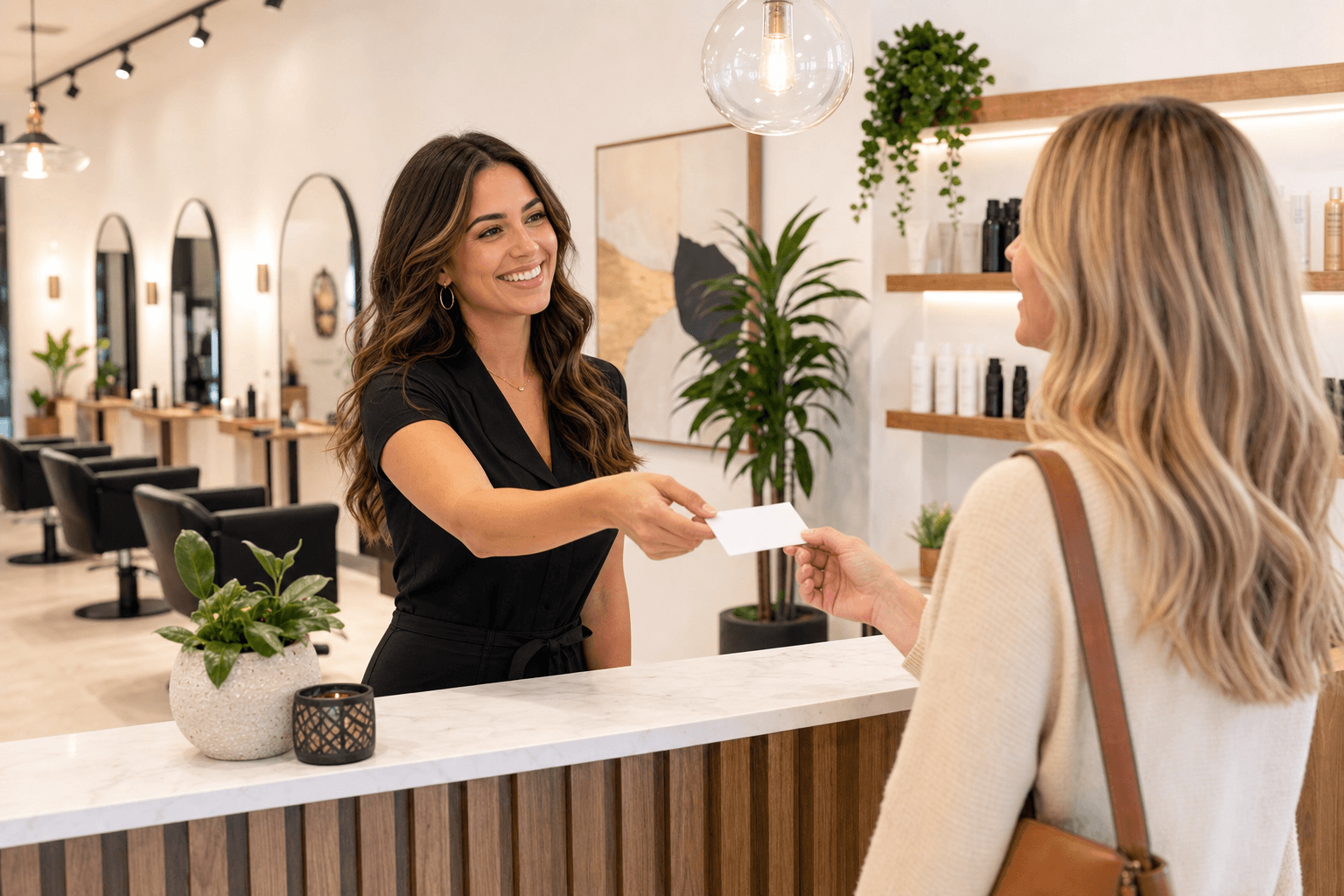
Hand clients a physical referral card or show them a QR code they can scan to get their unique referral link. A QR code on your reception desk or in your waiting area is an easy, low-cost touchpoint that doesn't require any staff effort after initial setup.
Handle the New Client Experience Deliberately
A referral gets someone through the door once. What keeps them coming back is the experience they have. Make sure your team knows when a client is referred — it's worth a brief acknowledgment: "Welcome — great to have you in, [Name] speaks highly of you!" Small touches like this validate the referral and make the new client feel like they're joining a community rather than just buying a service.
After their first appointment, send a follow-up message (text or email) thanking them for visiting and reminding them that they, too, can now refer friends and earn credits. This is how a single referral compounds into multiple new clients over time.
Review and Refine Every Quarter
A referral program is not a set-it-and-forget-it initiative. Every 90 days, pull your data and ask:
- How many new clients came in through referrals this quarter?
- What percentage of new bookings were referred?
- Which existing clients referred the most people? (Consider giving them a personal thank-you.)
- What was the average spend of referred clients vs. non-referred new clients?
- Did referred clients rebook at a higher rate?
Use these answers to adjust your reward amounts, refine your messaging, and identify your top referrers for special recognition. If your referral rate is flat, the issue is usually one of three things: the reward isn't compelling enough, clients don't know about the program, or the redemption process is too complicated.
Avoid These Common Mistakes
- Making the reward too small. A $5 discount on a $120 service doesn't move the needle. Match the reward to the perceived effort of making a recommendation.
- Burying the program. If clients have to ask about it, most won't. Put it front and center — on your menu, your receipts, your emails.
- Forgetting to issue rewards. This is a trust-killer. If you promise a reward and don't deliver it promptly, the referring client feels burned and is unlikely to refer again.
- Running the program indefinitely without review. Markets change, client bases evolve. A program that worked two years ago may need refreshing.
- Ignoring the quality of referred clients. If you're attracting clients who only come in once to redeem a discount, reconsider your reward structure. The goal is long-term clients, not one-time visitors.
For more strategies on keeping clients coming back after they've been referred, our guide on reducing no-shows at your salon covers the booking and reminder tactics that keep your calendar full. And if you want to present your services in a way that makes new clients feel confident booking, a well-designed digital service menu goes a long way toward setting expectations before they even walk in the door.
Frequently Asked Questions
How much should I offer as a referral reward for my salon?
A good starting point is $15–$20 in service credit for the referring client and $10–$15 off for the new client. The right amount depends on your average ticket size — the reward should feel meaningful relative to what clients typically spend. If your average service is $50, a $5 reward won't motivate anyone. If it's $150, $25 in credit is reasonable and still protects your margins.
Do I need special software to run a referral program?
No. Many successful salon referral programs run on nothing more than paper cards and a spreadsheet. That said, if your booking platform supports referral tracking or unique codes, use it — it saves time and reduces errors. The most important thing is having a consistent process, not fancy technology.
How long should it take before I see results from a referral program?
Most salons see measurable results within 60–90 days of actively promoting the program. If you're not seeing new referred clients within the first month, the issue is usually awareness — clients don't know the program exists. Increase your promotion at the chair and in your follow-up communications.
Should I promote my referral program on social media?
Yes, but don't over-rely on it. Social media is good for the initial launch announcement and occasional reminders. The highest-converting promotion happens in person — at the chair, at checkout, and in personalized follow-up messages. Social reach is broad but shallow; personal conversations are narrow but deep.
Can a referral program work for a solo stylist or small barbershop?
Absolutely. In fact, solo operators and small shops often see better results because they have tighter, more personal relationships with their clients. The mechanics are the same — define the reward, communicate it clearly, track it consistently, and deliver on your promises. The main adjustment is keeping the admin simple so it doesn't become a burden when you're the only one running the operation.
Ready to make it easier for new and referred clients to explore your services before they book? Build your digital salon menu with MenuHoster — no developer needed, no monthly fees to start. A polished, mobile-friendly service menu gives every referred client the confidence to book their first appointment and come back for more.
MenuHoster Team
Helping restaurants go digital